


A few years ago, someone asked me a simple question.
“How are you feeling?”
Not how things were going.
Not how my family was doing.
Not whether I was managing everything.
How I was feeling.
I remember pausing longer than I expected.
Not because I didn’t have feelings.
But because I wasn’t entirely sure how to answer.
I knew I was tired.
I knew I was carrying a great deal.
I knew life had been difficult.
But when it came to identifying what I was actually feeling beneath all of that, I found myself searching for words.
Looking back, I don’t think that was unusual.
I think many women have spent so much of their lives enduring that they have had very little opportunity to practice feeling.
From an early age, many of us receive messages about what is expected of us.
Be kind.
Be helpful.
Be responsible.
Don’t make things harder for others.
Stay strong.
Keep going.
Handle it.
And so we do.
We learn how to adapt.
How to cope.
How to manage.
How to push through difficult circumstances.
These are valuable skills.
Life requires resilience.
The problem is that somewhere along the way, many of us begin treating emotions as obstacles rather than information.
We learn to move around them.
Past them.
Through them.
Anything but sit with them.
Sadness becomes something to overcome.
Anger becomes something to suppress.
Loneliness becomes something to hide.
Grief becomes something to carry quietly.
Need becomes something to apologize for.
And over time, we become exceptionally good at functioning.
Even when we are hurting.
Especially when we are hurting.
I think this is one of the reasons emotionally exhausted women often look so capable from the outside.
They have spent years practicing endurance.
They know how to show up.
How to keep commitments.
How to care for others.
How to continue moving forward even when their own emotional reserves are running low.
I know this pattern well.
During some of the most difficult seasons of transitions, caregiving, loss, and responsibility in my own life, there was rarely time to fall apart.
There were appointments to attend.
Decisions to make.
People to care for.
Practical realities that required attention.
So I did what many women do.
I kept going.
And for a while, that was necessary.
The challenge came later.
When life became quieter.
When there was finally space.
When the responsibilities began to ease.
Because what I discovered was that emotions we postpone do not disappear.
They wait.
Patiently.
Quietly.
Until there is finally enough room for them to be felt.
Sometimes they arrive as tears that seem to come from nowhere.
Sometimes as exhaustion.
Sometimes as anxiety.
Sometimes as irritability.
Sometimes as a sadness we cannot immediately explain.
Not because we are broken.
But because we are human.
And feelings that have been carried for years eventually ask to be acknowledged.
I have come to believe that one of the greatest acts of self-compassion is learning to become curious about our emotional experience rather than judging it.
What if sadness is not weakness?
What if anger is not failure?
What if grief is not something to fix?
What if loneliness is not something to hide?
What if our emotions are simply trying to tell us something important about our lives?
That shift has changed the way I relate to myself.
Instead of asking:
“How do I stop feeling this?”
I am learning to ask:
“What might this feeling be trying to show me?”
That question creates space.
Space for honesty.
Space for understanding.
Space for healing.
I think many women are hungry for that space.
Not because they want to become more emotional.
But because they are tired of carrying emotions they have never fully allowed themselves to feel.
The truth is, endurance has helped many of us survive.
But survival is not the same thing as wholeness.
Eventually, there comes a time when continuing to push through is no longer the answer.
A time when healing asks something different of us.
Not more strength.
Not more resilience.
Not more endurance.
But more honesty.
More compassion.
More willingness to sit quietly with what is true.
And perhaps that is where returning to ourselves begins.
Not in fixing our feelings.
But in finally allowing ourselves to have them.
“Sometimes healing begins the moment we stop saying “I’m fine” when we are not.”
Weekly Living Room Reflection
Reflection often begins with awareness, but awareness alone rarely creates change. This week’s reflection is designed to help you gently explore the ideas we’ve been talking about together. There are no right or wrong answers - only an invitation to notice what has been quietly shaping your experience.
Many of us learned how to keep going long before we learned how to name what we were feeling. This reflection offers a gentle opportunity to expand your emotional vocabulary and become more familiar with your own inner experience.
Be gentle with yourself through this process. Take your time. Write honestly.
Peel back the layers to the deeper feelings, if you can.
Return to these pages whenever you need to.
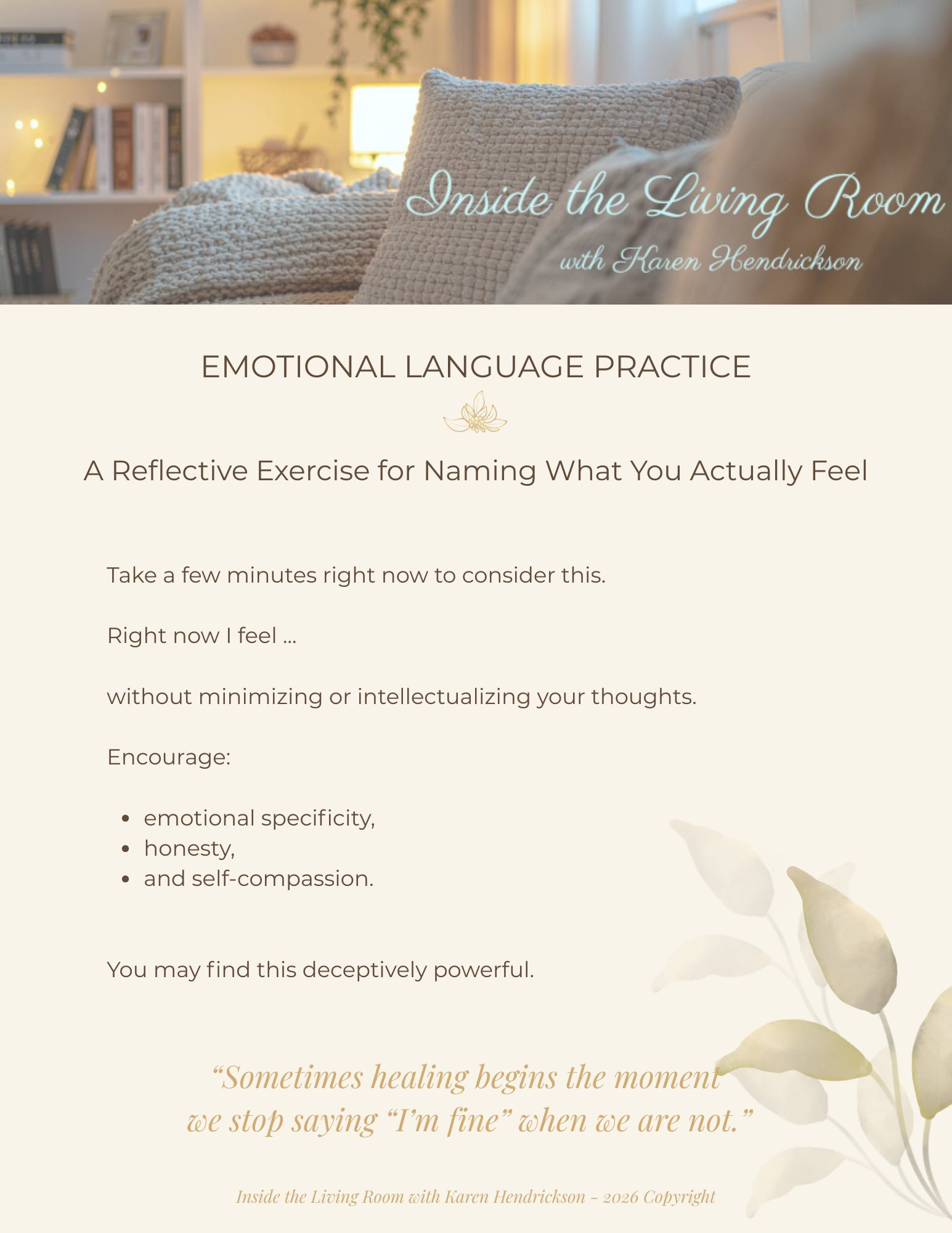
This exercise may have stirred emotions. Know you are not alone here. The intention is not to “fix” but to simply notice. Join the conversation and share any perspectives you may have.
Continuing the Conversation
In the coming weeks, I’ll be sharing additional essays, reflection practices, journaling resources, and conversations exploring emotional exhaustion, caregiving, grief, boundaries, and what it means to return to yourself after carrying too much for too long.
If you found yourself somewhere in this reflection, I invite you to subscribe and continue the conversation.
Until next time, be gentle with yourself.
You are welcome inside the Living Room.
Go Gently,
Karen
Inside the Living Room is a growing collection of essays, reflection tools, and conversations for women navigating emotional exhaustion, caregiving, grief, over-responsibility, and the journey of reconnecting with themselves.
I’ll come back for a slower deeper read with this one. Thanks Karen!