


I’ve been thinking about you. Not just this week. But throughout these past months, as we’ve sat together inside the Living Room.
I’ve wondered where you’ve been reading these words. Perhaps at the kitchen table before everyone else wakes. Perhaps in the quiet after another long day. Perhaps while sitting in your car, stealing a few moments before walking into yet another responsibility.
Or perhaps you’ve found yourself here because something inside you whispered,
“I can’t keep living like this.”
If that’s true, I want you to know something. You’re not alone. And perhaps more importantly... You’re not behind.
When we first began this conversation together, we talked about what it means to be “the strong one.”
How quietly that role can become our identity. How easy it is to become so practiced at carrying everyone else that we stop noticing the weight ourselves.
From there, we explored emotional overfunctioning. Hidden grief. Loneliness. Rest. Boundaries. The conversations we avoid. The parts of ourselves we slowly lose while trying to love everyone else well.
Each article has asked a different question. But I think they’ve all been leading us toward the very same place.
Toward you.
Not the version of you that everyone depends upon. Not the woman everyone describes as capable. Not the one who always knows what to do.
Simply ... You.
The woman beneath the roles. The responsibilities. The expectations. The woman who still has dreams. Who still longs for peace. Who still laughs. Who still wonders. Who still deserves tenderness.
Somewhere along the way, many of us began believing that returning our attention to ourselves was selfish. We became comfortable saying,
“I’m fine.”
“I’m okay.”
“It’s not about me.”
“I’ll deal with it later.”
And for a season ... Perhaps we needed to.
Life asked extraordinary things of us. Caregiving. Grief. Illness. Parenting. Marriage. Work. Aging parents. Unexpected change.
There are seasons when survival becomes the assignment. There is no shame in that. But survival was never meant to become a permanent address. Eventually, there comes a quiet invitation.
Not loud. Not dramatic. Gentle. Persistent. Almost like someone softly knocking at the door.
It asks: “Are you ready to come home now?”
Coming home to yourself doesn’t mean life suddenly becomes easier. It doesn’t mean grief disappears. Or that everyone around you suddenly understands your boundaries.
It doesn’t even mean you stop caring so deeply. It simply means that somewhere along the way, you decide that your own life deserves your attention too.
You begin asking different questions.
What do I need?
What feels true for me?
What brings me peace?
What no longer belongs to me?
Who am I becoming?
Those questions aren’t selfish. They’re sacred. Because they invite you back into a relationship that may have been waiting patiently for years.
The relationship with yourself.
I’ve learned something through my own experiences of caregiving, grief, and loss. The people we love deserve our compassion. But so do we.
Somewhere along the way, I forgot that. Maybe you have too. Perhaps that is why this work matters so much to me. Not because I believe women need another list of things to improve.
Quite the opposite.
I think we’ve spent enough of our lives believing we weren’t doing enough. I think what many women need is permission.
Permission to pause. Permission to rest. Permission to receive. Permission to speak honestly. Permission to stop carrying what was never theirs. Permission to matter. And perhaps, most importantly...
Permission to come home to themselves without apology.
If you’ve recognized yourself anywhere within these pages, I hope you leave this first season knowing one thing. You haven’t been trying to become someone new. You’ve been remembering someone.
The woman who has always been there. Quietly waiting beneath the responsibilities. Beneath the grief. Beneath the expectations. Beneath the survival.
She’s still there. She’s always been there. And I have a feeling she’s ready for what comes next. Because returning to yourself isn’t the end of the journey.
It’s where the next chapter begins.
Thank you for trusting me enough to pull up a chair beside you.
It has been an honour.
And if you’re willing...
I’d love to keep walking with you.
There is still so much possibility waiting for us inside the Living Room.
“Returning to yourself isn’t becoming someone new. It’s remembering who you’ve been beneath everything you’ve been carrying.”
This Week’s Living Room Reflection
Before we step into a new season together, I’d like to invite you to pause.
Growth often happens so quietly that we don’t recognize it until we stop long enough to look behind us.
This reflection isn’t about measuring progress.
It’s about noticing how your relationship with yourself may already be changing.
Take your time.
There is wisdom in looking back with compassion before looking ahead with hope.
Write gently. There is no finish line. Only another step toward yourself.
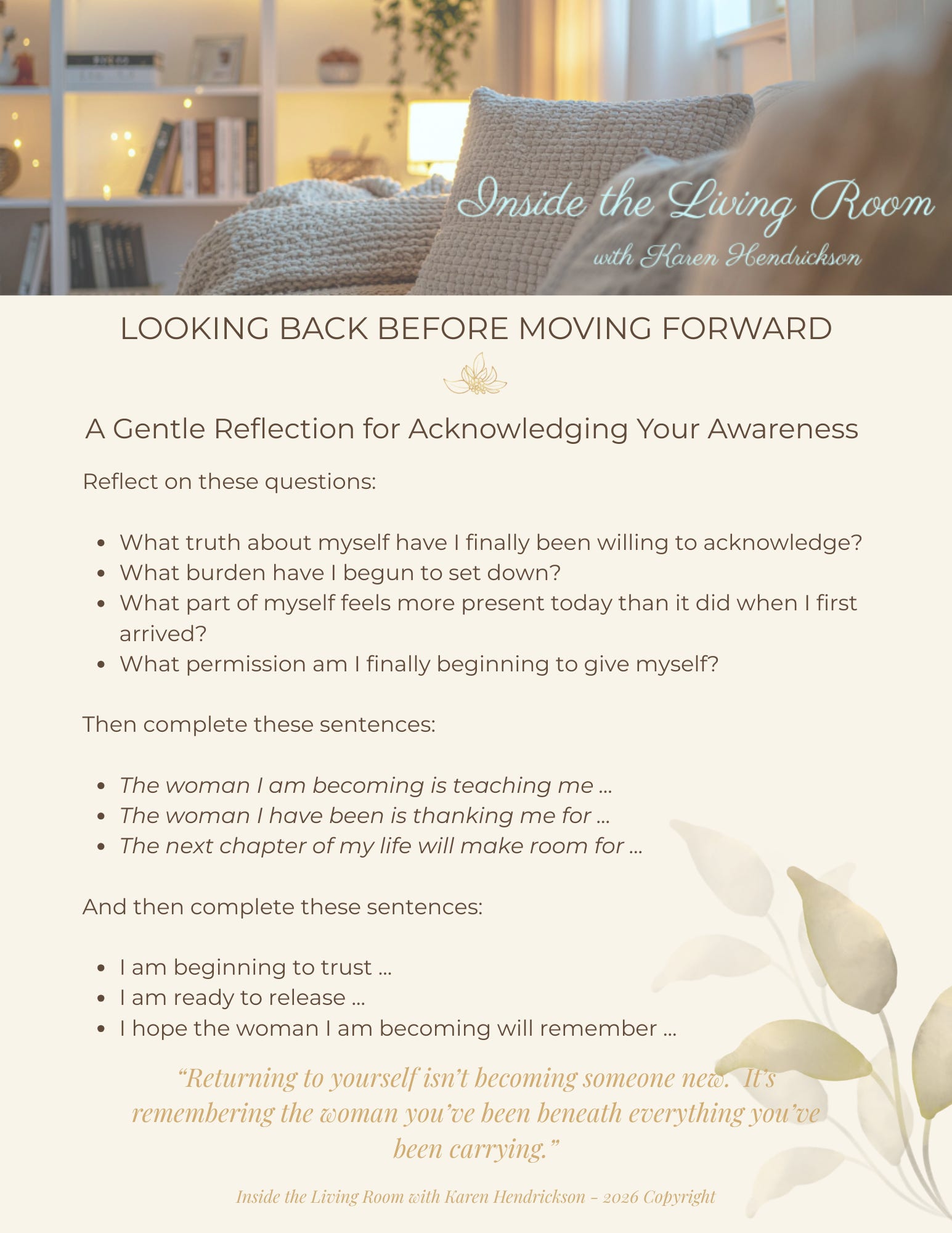
Continuing the Conversation
As you reflect on these past weeks, what has been the most meaningful truth you’ve discovered about yourself? I’d love to hear your thoughts in the comments below.
Next week, we’ll begin a new conversation.
We’ve spent time recognizing what you’ve been carrying, and remembering the woman beneath it all. Together, we’ll begin exploring what happens when you start living differently—how relationships shift, why boundaries are tested, and how to stay connected to yourself as you create a life that feels more like your own.
I hope you’ll pull up a chair. I’d love to have you with me.
Go gently,
—Karen
Writer, reflective practitioner, curator, and creator of Inside the Living Room—a space for women navigating emotional exhaustion, caregiving, grief, and the journey of returning to themselves.
_____________
Inside the Living Room is a growing collection of essays, reflection tools, and conversations for women navigating emotional exhaustion, caregiving, grief, over-responsibility, and the journey of reconnecting with themselves.
As always Karen your words land gently but with an invisible pull or gentle nudge. This first chapter has reminded me to offer myself the same grace I offer others in my doula work. I lost my husband in June this year after a devastatingly short cancer journey. His cancer was aggressive and unforgiving. He moved from a strong independent alpha male to a human reliant on others for the basics of life in a single handful of weeks. His frustrations of course spilled over when he felt safe to allow them. I knew this to be his outlet, but I guarded my feelings by letting the busyness of caring push my aching heart down deep. Those raw edges of caring are where I am learning to give myself grace. Both he and I knew we were loved, deeply and joyfully. I am grateful for continuing to learn about the lessons of loss and how growth is sometimes very uncomfortable. Grateful for you and your words, Elaine
This, “… was never meant to become a permanent address. “
Thanks for sharing your wisdom and compassion Karen. I’m all in for the next chapter and beyond. With gratitude.