


For a long time, I thought the hardest part would be learning to speak up.
Learning to identify my needs. Learning to tell the truth. Learning to ask for support.
After years of caregiving, responsibility, and quietly carrying more than my share, I imagined that finding my voice would be the turning point. And in many ways, it was. But what surprised me was what happened next.
I spoke. And sometimes it felt as though no one was really listening. At least not the way I had hoped. Perhaps you’ve experienced this too.
You finally gather the courage to say:
“I’m tired.”
“I need help.”
“I can’t keep doing this alone.”
“I’m struggling.”
“This isn’t working for me anymore.”
And instead of feeling understood, you find yourself on the receiving end of solutions. Advice. Explanations. Fixes. People tell you what you should do. What you should try. What you should think. How you should feel.
And while their intentions are often good, something important gets lost. You weren’t necessarily asking for answers. You were asking to be heard.
There is a profound difference between those two things.
I think many women know this experience intimately. Especially women who have spent years listening to everyone else. We know what it feels like to sit with someone in their pain. To witness their struggle. To offer presence instead of solutions. To understand that not every problem can be fixed. And so when we finally allow ourselves to be vulnerable, we often hope for something similar in return.
Not perfection. Not rescue. Just understanding. Just acknowledgment. Just someone willing to sit beside us and say:
“That sounds really hard.”
“I can see why you’re exhausted.”
“You’ve been carrying so much.”
“I understand.”
Yet that is not always what happens. Sometimes people feel uncomfortable. Sometimes they rush toward solutions because they don’t know what to do with vulnerability. Sometimes they minimize our experience because they want us to feel better. Sometimes they offer advice because they genuinely care.
And sometimes, if we’re honest, they have become so accustomed to seeing us as capable that they struggle to recognize our need for support. After all, we’ve spent years teaching people that we can handle it.
We’ve spent years saying:
“I’m fine.”
“I’ve got it.”
“Don’t worry about me.”
We’ve spent years carrying things quietly. And then one day we speak. And we’re surprised when people don’t immediately understand the depth of what we’re trying to say. That realization can be painful. Not because people don’t care. But because being heard and being cared about are not always the same thing.
Someone can love us deeply and still not know how to listen. Someone can want to help and still miss what we’re asking for. Someone can offer solutions while completely overlooking the need beneath them. The need to feel understood.
I have come to believe that one of the most vulnerable things a woman can say is not:
“I need help.”
It is: “I don’t need you to fix this. I need you to understand it.”
That sentence asks something different of a relationship. It asks for presence. Patience. Curiosity. Connection. And perhaps that is why it feels so risky. Because there is always the possibility that the other person won’t know how to respond.
The good news is that finding your voice is not dependent on other people’s reactions. Their response matters. But it does not determine whether your truth is valid. It does not determine whether your needs matter. It does not determine whether what you are feeling is real.
Part of finding our voice is learning to trust ourselves even when others don’t fully understand. Part of finding our voice is continuing to speak honestly without immediately translating our needs into something more comfortable for everyone else. And part of finding our voice is recognizing that support sometimes needs to be taught.
Sometimes the people who love us need help understanding what support actually looks like.
Not advice. Not solutions. Not fixing. Listening. Understanding. Being willing to stay present.Because sometimes what we need most is not for our burden to be removed. Sometimes we simply need someone willing to acknowledge that it exists. And perhaps that is where healing begins.
Not when everyone finally understands us perfectly.
But when we stop abandoning our own experience because someone else doesn’t know what to do with it.
“"Sometimes the first person who truly hears your voice is you.”
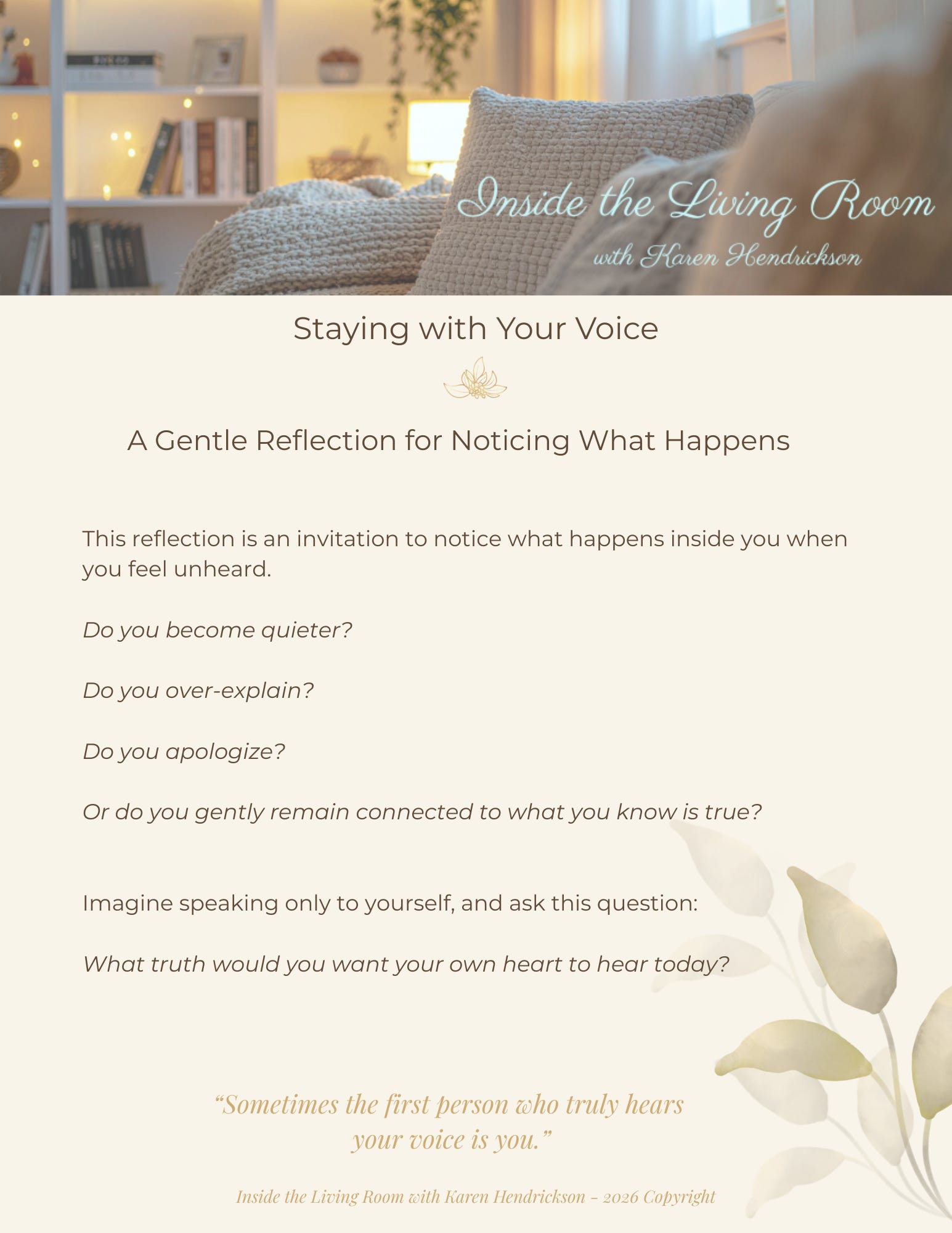
This Week’s Living Room Reflection
Finding your voice is courageous. Keeping it when others don’t immediately understand may be even more so.
This reflection is an invitation to notice what happens inside you when you feel unheard.
Continuing the Conversation
Have you ever shared something vulnerable only to receive advice when what you needed was understanding?
What helps you feel truly heard? I’d love to hear your thoughts in the comments below.
Until next time, be gentle with yourself.
Remember, there is always room for one more chair, Inside the Living Room.
Go gently,
—Karen
Writer, reflective practitioner, curator, and creator of Inside the Living Room—a space for women navigating emotional exhaustion, caregiving, grief, and the journey of returning to themselves.
_____________
Inside the Living Room is a growing collection of essays, reflection tools, and conversations for women navigating emotional exhaustion, caregiving, grief, over-responsibility, and the journey of reconnecting with themselves.