


For many years, I believed setting boundaries would feel empowering.
I imagined that once I became clear about what I needed, I would simply communicate it, and people would understand. Perhaps not immediately. But eventually. After all, healthy boundaries are reasonable. Respectful. Necessary.
Surely the people who love us would want us to have them.
What I’ve come to understand is that boundaries often reveal things we never expected. Not only about other people. But about ourselves.
Because setting a boundary is rarely the hardest part. The hardest part is what comes next. The conversations. The disappointment. The resistance. The repeated requests. The subtle guilt. The feeling that somehow you are being asked to defend a decision you have already made.
I think many women know this experience.
You finally say:
“I can’t do that.”
“I don’t have the capacity.”
“I need help.”
I’m not available.”
“I’ve decided not to take that on.”
And for a moment, you feel proud of yourself. Relieved. Clear. Certain. Then the questions begin.
“Are you sure?”
“But you’ve always done it.”
“Can’t you make an exception?”
“It would only take a minute.”
“Nobody else can do it.”
“I really need you.”
Or perhaps there are no questions at all. Perhaps the boundary is simply ignored. Dismissed. Stepped over. As though it was never spoken. That can be one of the most confusing parts of growth.
Especially for women who have spent years learning to use their voice. Because we assume that once we have expressed a boundary, the work is finished.
In reality, the boundary often begins there. A boundary is not simply something we say. It is something we continue to uphold. And that can feel uncomfortable. Particularly when we have spent much of our lives prioritizing other people’s comfort over our own.
I remember discovering that some people were perfectly happy with my growth as long as it didn’t require anything from them. As long as my boundaries remained theoretical. As long as they didn’t change expectations. As long as they didn’t alter familiar patterns.
But boundaries do change things. That’s the point. A boundary that changes nothing is often not a boundary at all. It’s a preference.
Real boundaries require adjustment. And adjustment can create discomfort. Not because anyone is wrong. Because people become accustomed to certain roles. For years, many women have been the helper. The organizer. The caregiver. The emotional support person. The one who makes things work.
When that role changes, others must adapt. Some do. Some don’t. Some celebrate your growth. Others quietly resist it. Not necessarily because they are unkind. But because your boundary requires them to take responsibility they may have become accustomed to you carrying.
And that is where many women begin doubting themselves. We mistake resistance for evidence that we have done something wrong. We interpret disappointment as proof that our boundary is unfair. We assume that because someone doesn’t like our boundary, we should reconsider it.
But healthy boundaries are not measured by other people’s approval. They are measured by whether they honour what is true and sustainable for us. That does not mean boundaries should be rigid. Or unkind. Or inflexible. But it does mean they deserve to be respected. Including by us.
I think one of the most important lessons I’ve learned is this:
People often respond to a new boundary according to how much they benefited from the absence of one.
That realization can be uncomfortable. But it can also be clarifying. Because it reminds us that another person’s reaction does not automatically determine the validity of our choice.
The goal is not to become difficult. The goal is not to stop helping. The goal is not to stop caring. The goal is to stop abandoning ourselves in the process. And sometimes that means repeating the boundary.
Again. And again. And again.
Not because the boundary wasn’t clear. Because consistency is what teaches people we mean it. Eventually, something interesting begins to happen.
The discomfort lessons. The guilt softens. The conversations become easier. The boundary becomes less about defending yourself and more about simply living in alignment with what you know to be true. And perhaps that is what growth looks like.
Not the absence of pushback. But the willingness to remain connected to yourself even when pushback arrives.
Because every time you honour a healthy boundary, you send yourself a quiet message:
My needs matter too.
And for many women, that message is long overdue.
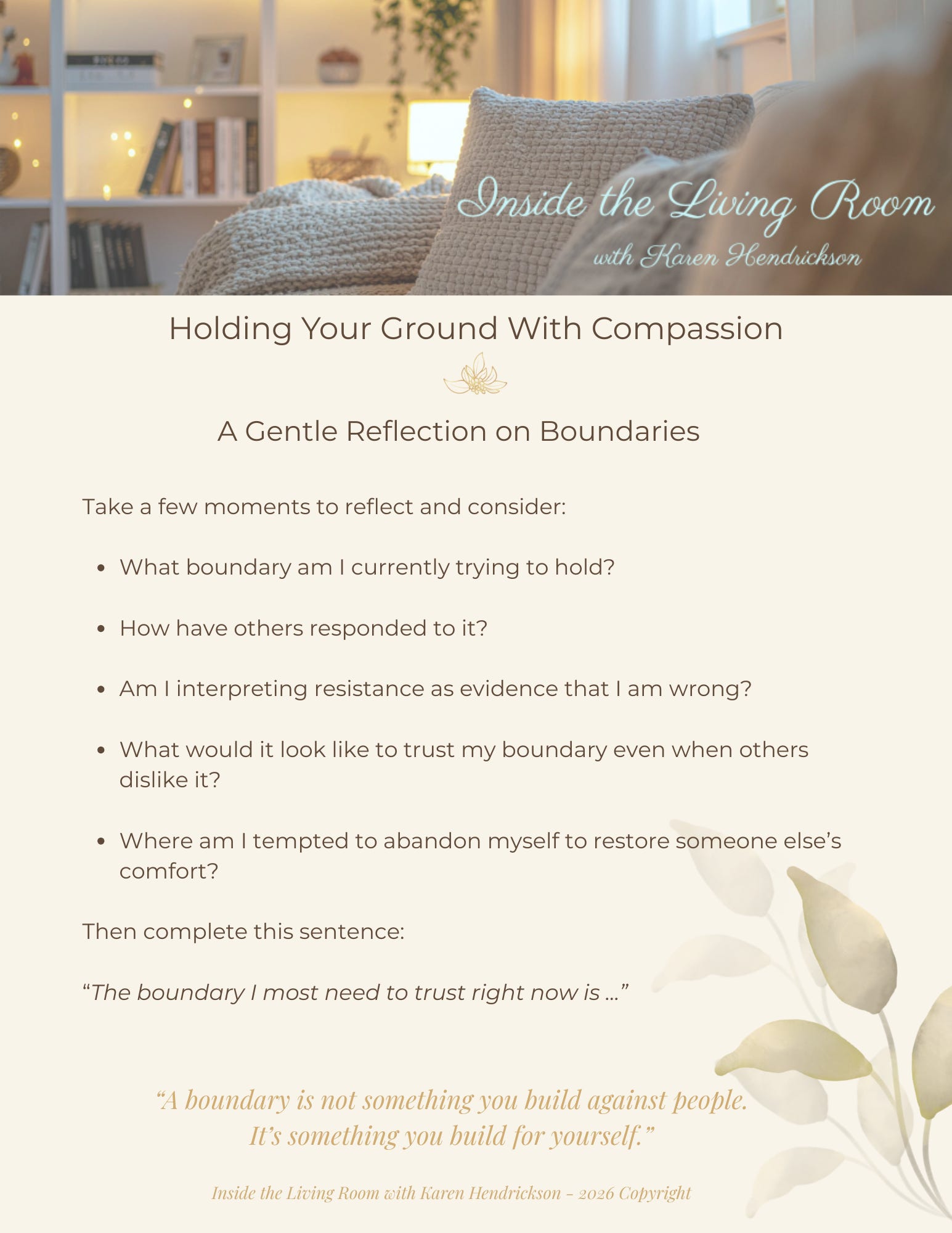
“A boundary is not something you build against people. It is something you build for yourself.”
This Week’s Living Room Reflection
This week’s reflection reminds us that boundaries are not walls. Take some quiet time, maybe in a comfy chair if you can, and consider the following.
Write honestly. Write gently.
Remember boundaries aren’t walls. They are expressions of self-respect.
Have you ever set a boundary only to have it questioned, ignored, or challenged? What helped you stay grounded in your decision? I’d love to hear your comments below.
Continuing the Conversation
Setting boundaries is important. Finding your voice is important. But perhaps the most transformative practice of all is learning not to abandon yourself when life becomes uncomfortable. Next week, we’ll explore what it truly means to stay beside yourself.
Until next time, be gentle with yourself.
Remember, there is always room for one more chair, Inside the Living Room.
Go gently,
—Karen
Writer, reflective practitioner, curator, and creator of Inside the Living Room—a space for women navigating emotional exhaustion, caregiving, grief, and the journey of returning to themselves.
_____________
Inside the Living Room is a growing collection of essays, reflection tools, and conversations for women navigating emotional exhaustion, caregiving, grief, over-responsibility, and the journey of reconnecting with themselves.