


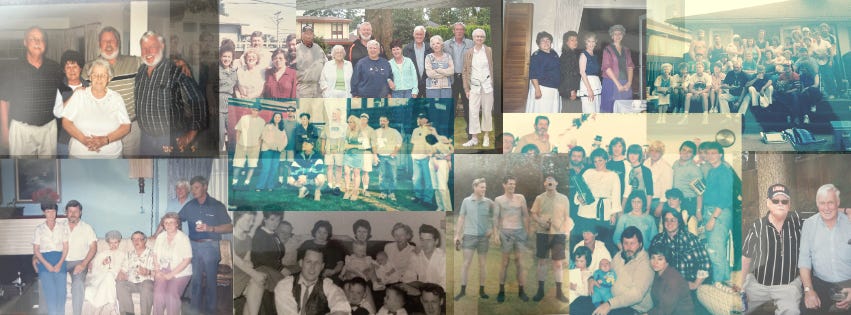
There are things from childhood we don’t recognize as important while we are living them. They are simply life.
The houses we walked into without knocking. The people whose faces were so familiar we couldn’t imagine a world without them. The cousins who were simply our cousins, long before we understood how unusual it might be to eventually have forty-some of them.
The annual family BBQs. The Boxing Day gatherings. And for me, cousin sleepovers.
Each gathering held the Aunts and Uncles gathered around tables, or sitting on lawn chairs and patio stairs, talking and laughing - so much laughter - while children ran in and out of rooms, or in and out of lawn chairs in the yard.
At the time, none of it felt like legacy. It was just family.
My mom was one of six siblings, and between them, they created an enormous family. There were so many of us that I’m not sure I ever really stopped to think about it. There were cousins close to my age, cousins older than me, cousins younger than me. Eventually, there were second cousins and spouses and children and grandchildren.
When I think back to those early years, the memories are tender, yet some memories are particularly so. Sleepovers with my cousins, Kim and Janet. We three were the best of cousin friends, always looking forward to summer sleepovers, fun, and a simple, unrecognized belonging in those days.
The kind of childhood nights where staying at your cousins’ house felt like an adventure, even though you were still safely inside the circle of family. We played. We laughed. We whispered when we were supposed to be sleeping. We knew each other in that uncomplicated way children sometimes do—before teenage years, marriages, careers, geography, and responsibilities began pulling our lives in different directions.
I didn’t know then that decades later I would remember those times as tenderly as I do now. I certainly didn’t understand that I was learning something about belonging. I just knew I was with my cousins. And I always felt at home.
The Gatherings We Thought Would Always Be There
The annual family BBQ was another one of those things we could count on.
Everyone came. There was food—always too much food. There were ball games and badminton, bocce, and sometimes pool at our house. There were buckets of laughter and storytelling, and catching up. Children ran around while aunts and uncles visited.
Uncles compared beer bellies and jokes, made bets on losing weight, and envied the skinny guys. Aunts laughed about the uncles, tended to the food and their kiddos, and brought a steady comfort to all of it.
Sometimes we ate too much. Sometimes we drank too much. Sometimes I imagine the same stories were told year after year. And somehow that was part of the comfort too.
Then there was Boxing Day. Christmas belonged to our individual families, but Boxing Day seemed to belong to all of us.
Another gathering. A crowded house with crowded rooms. Another day when we all came together and were reminded, without anyone needing to say it:
You belong here.
I have to admit, there were times as a younger adult, I didn’t appreciate these gatherings in the way I do now. In fact, sometimes I begrudged my mom giving me the date of a BBQ and then telling me I had to be there.
When you grow up with traditions like that, you assume they will always be there. You don’t imagine a time when the people who created them won’t be. You don’t look around the room and think, Remember this.
You don’t know you should.
Our Aunts and Uncles
When I think about our parents’ generation now, what stays with me most is how much they seemed to enjoy one another. They were siblings, which means I am sure there were disagreements and old wounds and irritations and complicated histories we children knew little about.
Families are families, after all. They weren’t perfect. But they loved one another. And they kept coming back together.
There is something about that I appreciate more now than I ever could have as a child, because family doesn’t remain connected simply because people share DNA. Connection has to be tended. Watered. Chosen. Just as all relationships do.
Someone has to invite. Someone has to host. Someone has to make the potato salad and set out the chairs and phone the relatives and say, Are you coming?
People have to decide that gathering matters. Our parents did that. Again and again for over 60 years. Thankfully, one cousin is making this decision for us again. Opening his home and reminding us. This still matters.
Perhaps that was one of the greatest things our parents gave us. They taught us that family wasn’t only who you were related to. Family was something you participated in. Something you showed up for.
And Then, Somehow, We Became Them
Most of our aunts and uncles are gone now. Even writing those words continues to feel strange. Because in my mind, I can still see them all gathered together.
I can still picture that generation at the centre of it all. They were the grown-ups. They were the parents. They were the keepers of the family history. They knew the stories that came before us.
And then, one by one, they left.
For the past few years, there hasn’t been an annual family BBQ. Life carried everyone in different directions. The cousins became parents and grandparents ourselves. We built lives and families and traditions of our own. And without really noticing when it happened, we moved into their place in the family story.
We are now the elders here. Us, together. The cousins.
That sentence still stops me. Because surely the elders are our parents. And how can we ever replace them? We simply can’t.
Surely they are still the ones sitting together while the rest of us run around living our lives. Except they aren’t. At least not here on this earth with us. Yet I know many of us cousins see them all gathered together somewhere in the heavens, still laughing and loving, enjoying each other’s company, and watching over all of us.
Because now it is us. We are the ones who remember. We are the ones who know the stories. We are the ones who can tell the younger generations who their great-aunts and great-uncles were and what they were like. We are the ones who remember the Boxing Days. We remember the BBQs. We remember being children together. We remember where we came from.
What They Actually Left Us
My understanding of inheritance has changed so much in these past few years.
There are the things people leave behind that can be held in our hands. Photographs. Jewelry. Furniture. Recipes. Objects that once sat in their homes and now sit in ours. But there is also another kind of inheritance. The things we carry without realizing we inherited them. A deeper one. One that isn’t held in our hands, but held in our hearts.
This is a sense of belonging. A belief that there should always be room for one more chair. The instinct to feed people when they arrive. The importance of gathering. The understanding that family relationships are worth tending across years and distance. The knowledge that we come from somewhere.
Our parents left us that. Maybe not intentionally. But they have left us that.
I doubt they sat around those BBQs thinking they were creating an intergenerational legacy. They were probably just trying to have some fun, get dinner on the table, and keep track of all those children. But they were creating one nonetheless.
They gave us roots before we understood how much we would someday need them.
And those roots are still there. They exist in the relationships between cousins who may not see one another often but share a history that cannot be recreated with anyone else.
Because there is something particular about a cousin. A cousin remembers a version of you that the people you meet later in life never knew. They know something about the family you came from because they came from it, too. They remember the characters. The houses. The gatherings. The stories.
Sometimes they even remember things about your parents that you have forgotten. There is comfort in being known in this way, across that much time.
The Ones Coming After Us
I am learning that being an elder means realizing that legacy doesn’t preserve itself. Someone has to carry it forward. Our children and grandchildren won’t remember our aunts and uncles the way we do. Some will never have met them. They won’t know the sound of their laughter or the expressions on their faces when they told a story.
But they can know what those people created. They can experience it when we gather. They can hear it when we tell the stories. They can feel it when they walk into a room filled with cousins and second cousins and children and grandchildren and understand:
These are my people, too.
That may be our responsibility now. Not to recreate everything exactly as it was. We couldn’t even if we tried.
Life changes. Families change. Traditions change. People die. New babies arrive.
And we can preserve the thing underneath all of it.
The belonging.
The knowing that there is a place where your history is shared. The understanding that family is imperfect and complicated and occasionally maddening—and still worth showing up for. The knowledge that you are part of something larger than your own individual life.
The Ordinary Things Become the Sacred Things
I wish I had understood all of this when I was younger. I wish I had known that one day I would miss the sight of our parents gathered together. That I would think about those BBQs with such tenderness. That Boxing Day would become something I looked back on, instead of forward to. And that childhood sleepovers with Kim and Janet would still live somewhere inside me all these years later.
But perhaps we aren’t supposed to know.
Maybe part of being human is that we live the ordinary days without realizing which ones will eventually become sacred in our memory. We don’t know which photograph will someday make us cry. We don’t know which voice we will desperately wish we could hear again. We don’t know which crowded family gathering will someday become one of the places we would give almost anything to return to for an afternoon.
I guess the lesson isn’t to hold onto the past, but to pay attention to the present. To look around when the family gathers now. To notice the cousins who have grown older beside us. To watch our children talking. To hold the newest babies. To listen to the noise. To tell the stories. To take the photograph.
And to understand that somewhere in the room, another childhood memory is being made. Another cousin is finding a friend. Another little person is learning, without anyone explaining it:
This is where I belong.
Our parents couldn’t stay. None of us can. But what they created did. It lives in us.
And now it is ours to carry.
This is my family.
These are my people.
I know where I come from.
And isn’t this one of the greatest inheritances any of us can receive?
A song for this story:
These Are the Days — Van MorrisonBecause, maybe … just maybe … that is what our parents understood before we did: these ordinary days of gathering, laughing, eating, telling stories and simply being together were the days we would one day long to have back with them all.
In honour of:
My grandparents, Dave & Dorothy Henderson
My parents, Elizabeth (Betty)- nee Henderson & Ernie Turner
My Aunts and Uncles:
Dick & Terry Henderson
George & Phil Henderson
Dave & Ann Marie Henderson
Bob & Claire Henderson
Pat - nee Henderson & George Nichol
And to all the cousins, their families, and their children’s families, too.
This is my family.
These are my people.
I know where I come from.
If this story stirred something in you, perhaps it has reminded you of one of your own.
The moments that shape us are rarely the loud ones. They are often the quiet experiences that continue to echo through generations, inviting us to see our lives with fresh eyes.
Thank you for letting me share this part of mine.
Until next time,
Go gently,
Karen
I’d love to hear one of your stories. If this piece brought a memory to mind, you’re always welcome to share it in the comments. Sometimes, the stories we tell one another become the stories that stay with all of us.
Inside the Living Room is a growing collection of essays, reflection tools, and conversations for women navigating emotional exhaustion, caregiving, grief, over-responsibility, and the journey of reconnecting with themselves.