


For a long time, I imagined that awareness would be the hard part.
Recognizing my exhaustion. Acknowledging my grief. Understanding how much responsibility I had been carrying. Learning the difference between caring and carrying. Finding language for experiences I had spent years quietly living.
And in many ways, those things were difficult.
But what surprised me most was what happened next. What happened when I started changing. Because awareness changes us.
Eventually, the woman who has spent years saying yes begins saying no. The woman who has spent years carrying everything begins setting some of it down. The woman who has spent years prioritizing everyone else’s needs begins considering her own. And while those changes may be healthy, they are not always comfortable.
Not for us. And sometimes not for the people around us.
I think many women expect that once they begin setting boundaries, everything will immediately feel lighter.
Sometimes it does. But often there is another season first.
A season of adjustment. A season of uncertainty. A season where old patterns begin shifting, and everyone involved must learn something new. Including us.
I remember discovering that some of the responsibilities I had been carrying were never actually mine. They had simply become mine because I was willing to carry them.
Or because I was afraid of what might happen if I didn’t. Or because carrying them felt easier than disappointing someone. Or because somewhere along the way, I had confused love with responsibility.
As I began questioning those patterns, I expected relief. What I didn’t expect was guilt. The guilt of saying no. The guilt of asking for help. The guilt of disappointing people. The guilt of no longer being available in all the ways I had always been available.
I think many women know this feeling.
We have spent years being praised for our selflessness. Years of being appreciated for our reliability. Years of being known as the person who can be counted on. And when we begin changing those patterns, it can feel as though we are somehow becoming less caring. Less generous. Less helpful. Less good.
But what I have come to understand is that healthy boundaries do not make us less compassionate. They simply make compassion sustainable.
The challenge is that not everyone welcomes those changes immediately. Some relationships adapt beautifully. Others struggle. Because every relationship develops patterns. Unspoken agreements. Expectations. Roles.
And when one person changes, the entire system shifts. The woman who always said yes may begin saying no. The woman who always solved problems may stop rescuing. The woman who always absorbed everyone’s emotions may begin returning responsibility to where it belongs.
And sometimes people are surprised by that. Sometimes they resist. Not necessarily because they are selfish. But because they too became accustomed to the old arrangement.
This is where many women become discouraged. They assume the discomfort means they are doing something wrong. That the guilt is a sign they should go back. That other people’s disappointment means their boundaries are unfair.
But discomfort is not always evidence of wrongdoing. Sometimes it is evidence of change. Sometimes, it is evidence that old patterns are loosening their grip. Sometimes it is evidence that we are learning a new way of being in relationship with ourselves and others.
I think one of the most important lessons I have learned is this:
Not everyone will celebrate your healing. Not because they don’t love you. But because your healing changes the role you have played in their lives. And that can take time for everyone to adjust to.
The goal is not to become hard. Or selfish. Or unavailable. The goal is to remain connected to yourself while caring for others.
To support without carrying. To love without losing yourself. To give without abandoning your own needs. And perhaps most importantly, to trust that healthy relationships can survive honesty.
They can survive boundaries. They can survive change. In fact, they often become stronger because of them.
If you find yourself in this season right now, I want you to know something.
The guilt will lessen. The discomfort will soften. The new boundaries may eventually feel normal. The voice you are finding may become easier to trust. And the life you are creating may begin to feel more like your own.
Not because you stopped caring. Because you finally made room for yourself within the care you offer others. That is not selfish. That is healthy. And perhaps that is what returning to yourself looks like.
Not becoming someone different.
But learning to include yourself in the life you have spent so many years giving away.
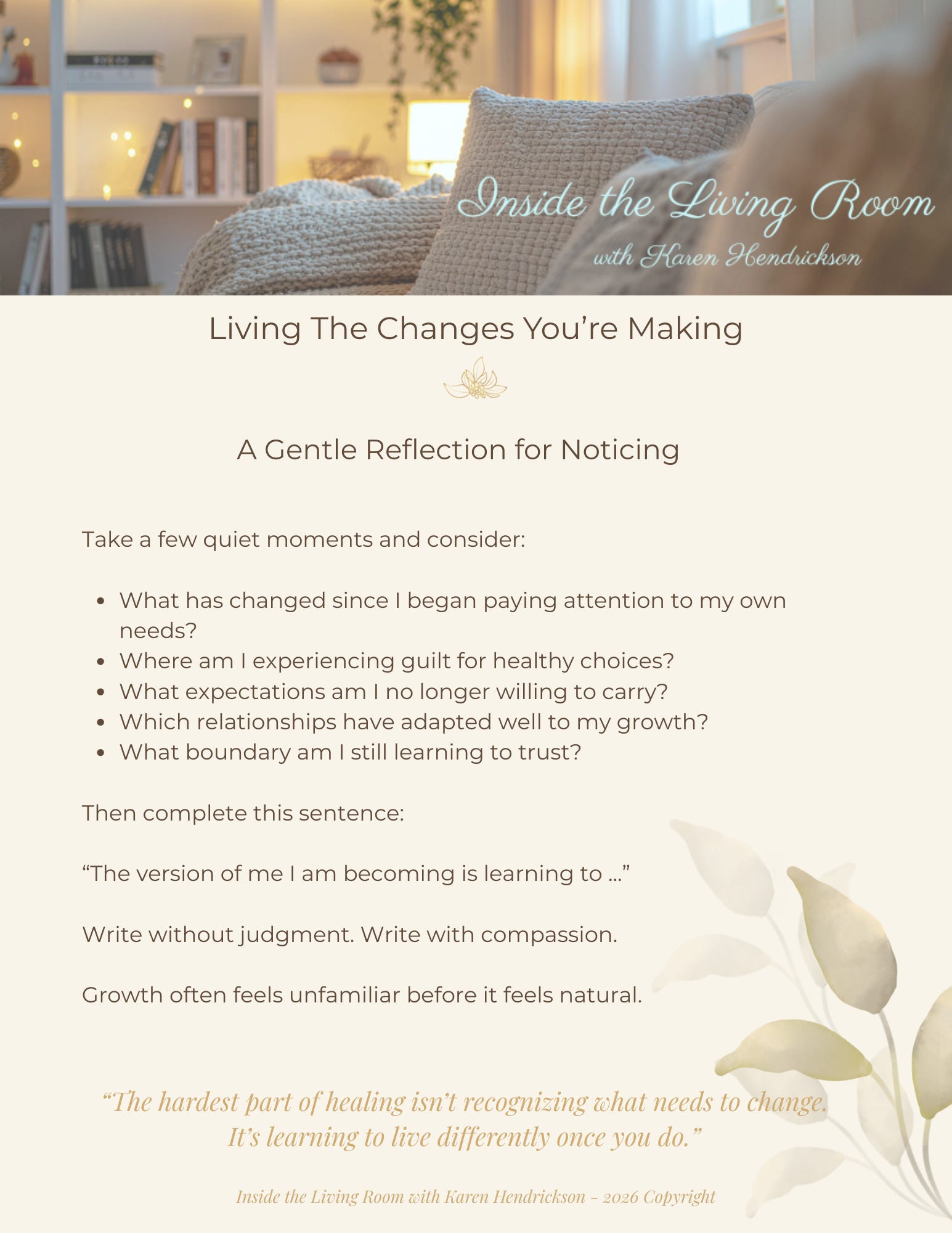
“The hardest part of healing isn’t recognizing what needs to change. It’s learning to live differently once you do.”
Weekly Living Room Reflection
This week’s reflection is designed to help you gently explore the ideas we’ve been talking about together. Over the past several weeks, maybe you’ve noticed the patterns that have quietly shaped your life.
Awareness is a beautiful beginning. But awareness eventually asks something more of us. It invites us to live differently. Today’s reflection isn’t about changing everything overnight. It’s about noticing the small ways you’re already beginning to choose you—and gently making room for those changes to continue.
Not perfectly. Not dramatically. Simply honestly.
Go slow. Take your time. Be gentle with yourself.
Have you experienced this season of change?
What surprised you most when you began setting boundaries, asking for support, or letting go of responsibilities that no longer belonged to you? I’d love to hear your thoughts in the comments below.
Continuing the Conversation
Next week we will explore something many of us experience after we begin changing: what happens when we finally speak honestly … and it feels like no one is really listening.
Until next time, be gentle with yourself.
You are welcome inside the Living Room.
Go gently,
—Karen
Writer, reflective practitioner, and creator of Inside the Living Room—a space for women navigating emotional exhaustion, caregiving, grief, and the journey of returning to themselves.
_____________
Inside the Living Room is a growing collection of essays, reflection practices, and conversations for women navigating emotional exhaustion, caregiving, grief, over-responsibility, and the journey of reconnecting with themselves.