


I don’t think most women lose themselves all at once.
At least, I didn’t.
There was no dramatic moment.
No single decision.
No obvious turning point.
Instead, it happened slowly.
Quietly.
Over years of responsibility.
Years of caregiving.
Years of showing up.
Years of doing what needed to be done.
If someone had asked me during those years whether I had lost myself, I would have said no.
I was still there.
I was still functioning.
Still working.
Still caring for the people I loved.
Still managing the countless responsibilities that life required.
From the outside, everything looked relatively intact.
But looking back now, I can see that something important had begun to fade.
Not my competence.
Not my ability to care for others.
My connection to myself.
Somewhere along the way, I stopped asking simple questions.
What do I need?
What brings me joy?
What do I want?
What matters to me now?
Those questions slowly disappeared beneath more urgent ones.
Who needs me?
What has to be done?
What problem needs solving?
What am I forgetting?
And for a while, that made sense.
There are seasons in life when survival requires our attention.
Seasons when caregiving, grief, illness, parenting, work, or crisis leave very little room for self-reflection.
The challenge is that some of us stay in those seasons emotionally long after they have ended.
We become so accustomed to putting ourselves last that it begins to feel normal.
We stop noticing what we have given up.
Because it happens gradually.
A postponed dream here.
A forgotten hobby there.
An abandoned interest.
A neglected friendship.
A desire quietly set aside.
A need left unmet.
None of it seems significant in isolation.
But over time, those small acts of self-neglect begin to accumulate.
And eventually, we find ourselves wondering why we feel disconnected.
Why life feels flat.
Why joy feels harder to access.
Why we feel strangely absent from our own lives.
I remember recently, after years of caregiving, when someone asked me a simple question.
“What do you enjoy doing?”
I should have had an answer.
Instead, I found myself struggling.
Not because there was nothing I enjoyed.
But because I had become so disconnected from that part of myself that I genuinely didn’t know anymore.
That realization was unsettling.
And also deeply revealing.
It showed me how easy it is to become an expert in everyone else’s needs while losing touch with your own.
I think many women experience this.
Particularly those who have spent years being responsible.
The strong one.
The helper.
The caregiver.
The organizer.
The dependable one.
These roles are often meaningful.
But when they become our entire identity, something important can get lost.
We begin to confuse who we are with what we do.
We become known for our reliability rather than our humanity.
Our usefulness rather than our uniqueness.
And eventually, we stop recognizing ourselves.
Not completely.
But enough to feel the absence.
The good news is that losing yourself quietly does not mean you are gone.
It simply means there are parts of you waiting to be rediscovered.
Parts that became buried beneath responsibility.
Parts that have been patient.
Waiting.
Not demanding attention.
Just waiting for space.
I have come to believe that reconnecting with ourselves rarely begins with dramatic change.
It begins with noticing.
Noticing what brings relief.
What sparks curiosity.
What creates a sense of aliveness.
What makes us feel more like ourselves.
It begins with remembering.
The books we used to love.
The places we felt most at peace.
The conversations that energized us.
The dreams we once carried.
The parts of ourselves that still matter.
Because they do still matter.
Even now.
Especially now.
The goal is not to become a completely different person.
The goal is not reinvention.
The goal is reconnection.
A gentle return to the parts of yourself that never truly disappeared.
Only became harder to hear beneath the noise of survival.
And perhaps that is where healing begins.
Not in becoming someone new.
But in remembering who you have been all along.
“You do not need to become someone new. You simply need permission to return to yourself.”
Weekly Living Room Reflection
Reflection often begins with awareness, but awareness alone rarely creates change. This week’s reflection is designed to help you gently explore the ideas we’ve been talking about together. There are no right or wrong answers - only an invitation to notice what has been quietly shaping your experience.
When we’ve spent years focused on everyone else, it can be surprisingly difficult to remember ourselves. This isn’t about reinventing who you are. It’s about reconnecting with the parts of you that may have been waiting patiently beneath years of responsibility.
Take your time. Write honestly. Return to these pages whenever you need to.
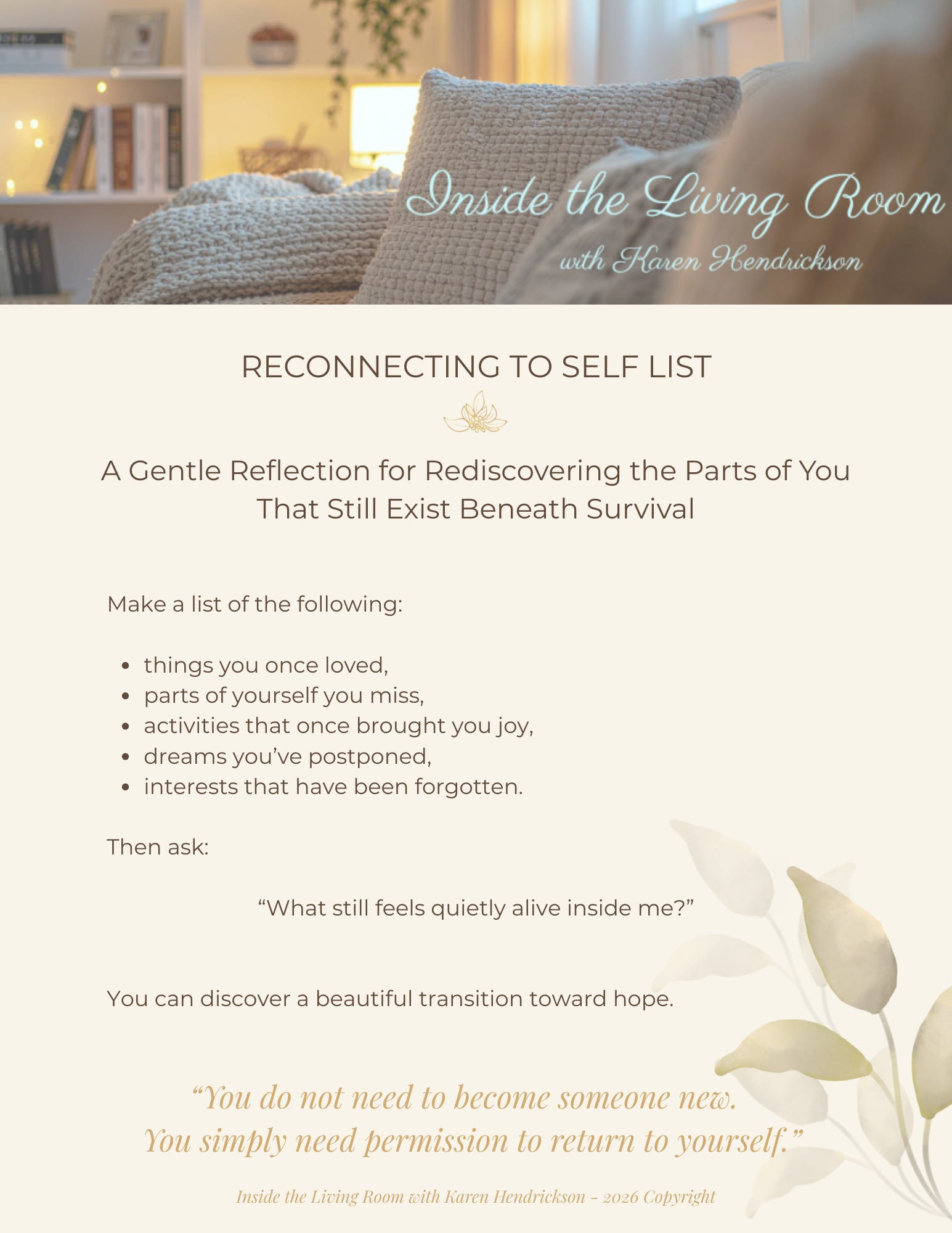
No one is alone in the quiet loss of yourself. Please share one thing that you have remembered that brings you joy. Imagine the shared joy we can experience if every reader shares one thing that brings them joy. Please share!
Continuing the Conversation
In the coming weeks, I’ll be sharing additional essays, reflection practices, journaling resources, and conversations exploring emotional exhaustion, caregiving, grief, boundaries, and what it means to return to yourself after carrying too much for too long.
If you found yourself somewhere in this reflection, I invite you to subscribe and continue the conversation.
Until next time, be gentle with yourself.
You are welcome inside the Living Room.
Go gently,
— Karen
Inside the Living Room is a growing collection of essays, reflection tools, and conversations for women navigating emotional exhaustion, caregiving, grief, over-responsibility, and the journey of reconnecting with themselves.
One thing that brings me joy: finding a pretty stamp and posting a handwritten letter to a friend. Also, receiving a hand written letter.