


For much of my life, I believed that staying quiet was often the kind thing to do.
Not always.
But often.
There were times when it seemed easier to let something go.
Easier to avoid conflict.
Easier to keep the peace.
Easier to tell myself that my feelings weren’t that important.
After all, everyone was carrying something.
Everyone had their own struggles.
Everyone was doing the best they could.
And so, like many women, I became skilled at managing discomfort internally rather than expressing it externally.
I learned how to have conversations in my head instead of in real life.
How to explain away disappointment.
How to minimize hurt.
How to convince myself that certain things simply weren’t worth talking about.
Sometimes that was true.
But not always.
What I’ve come to understand is that silence has a cost.
Not every silence.
Not every unspoken thought.
But the kind of silence that asks us to repeatedly abandon our own truth.
The kind that requires us to suppress what we genuinely feel.
The kind that slowly disconnects us from ourselves.
I think many emotionally responsible women know this pattern.
We tell ourselves:
It’s not a big deal.
I don’t want to upset anyone.
This isn’t the right time.
They have enough on their plate.
Maybe I’m overreacting.
Maybe I should just let it go.
And sometimes we do.
Once.
Twice.
A hundred times.
Until eventually, we stop noticing how often we have chosen peace over honesty.
Not because we are weak.
Because we are caring.
Because we are thoughtful.
Because we understand the complexity of relationships.
Because we know what it feels like to carry pain, and we do not want to create it for someone else.
But there is a difference between kindness and self-abandonment.
And many women cross that line without realizing it.
I know I have.
There have been seasons in my life when my energy was so focused on caring for others that I stopped expressing my own needs entirely.
Not intentionally.
Gradually.
I convinced myself that certain conversations could wait.
That my disappointment wasn’t important.
That my exhaustion didn’t need to be spoken aloud.
That my feelings would eventually sort themselves out.
Sometimes they did.
Sometimes they didn’t.
What often remained was a quiet accumulation of things unsaid.
Not dramatic resentments.
Small truths.
Small hurts.
Small needs.
Small disappointments.
The kinds of things that seem manageable in isolation.
But over time, begin creating distance.
Distance from ourselves.
Distance from others.
Distance from the life we are actually living.
Because relationships can only be as honest as the conversations we are willing to have.
And when we continually hide parts of our experience, we also hide parts of ourselves.
One of the hardest things I have learned is that people cannot respond to needs they do not know exist.
They cannot understand feelings that are never expressed.
They cannot support truths that remain hidden.
That realization can feel uncomfortable.
Partly because many of us have spent years believing that asking for understanding is burdensome.
That expressing disappointment is selfish.
That speaking honestly risks rejection.
And sometimes it does.
Honest conversations do not guarantee easy outcomes.
They do not ensure agreement.
They do not eliminate discomfort.
But avoiding them does not eliminate discomfort either.
It simply relocates it.
Instead of existing between people, it settles within us.
It becomes resentment.
Loneliness.
Disconnection.
Exhaustion.
The feeling that no one truly understands us.
When the truth is that we have not fully allowed ourselves to be understood.
I am not suggesting that every feeling needs to be shared.
Nor am I suggesting that every relationship can hold every truth.
Discernment matters.
Timing matters.
Safety matters.
But so does honesty.
Especially the honesty we offer ourselves.
Because before we can speak a truth, we often have to admit it.
We have to stop minimizing it.
Stop explaining it away.
Stop convincing ourselves that it does not matter.
We have to become willing to say:
This hurt.
I am tired.
I need support.
I feel lonely.
I want something different.
I cannot keep carrying this alone.
Those are not signs of weakness.
They are signs of self-respect.
Perhaps that is the invitation hidden within honest conversation.
Not confrontation.
Not conflict.
Connection.
The possibility of remaining connected to ourselves while being in relationship with others.
The possibility that our truth deserves a place in the room, too.
And perhaps that is where healing begins.
Not when everyone agrees with us.
But when we stop abandoning what we know to be true.
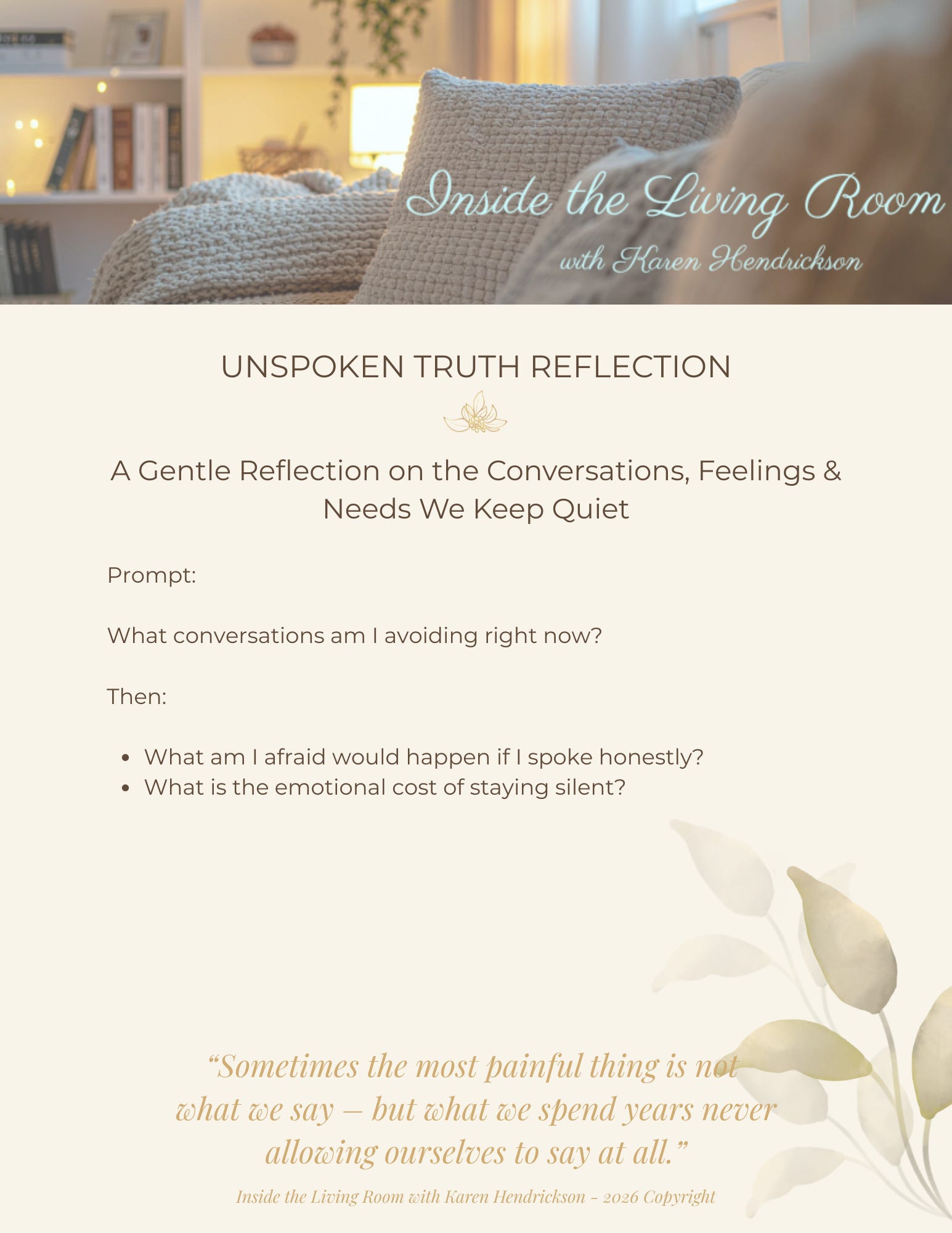
“Sometimes the most painful thing is not what we say — but what we spend years never allowing ourselves to say at all.”
Weekly Living Room Reflection
Reflection often begins with awareness, but awareness alone rarely creates change. This week’s reflection is designed to help you gently explore the ideas we’ve been talking about together. There are no right or wrong answers - only an invitation to notice what has been quietly shaping your experience.
The words we leave unsaid don’t simply disappear. They often become the weight we continue carrying. This reflection invites you to explore what has remained unspoken and what it might look like to begin giving those truths a voice.
Take your time. Write honestly. Return to these pages whenever you need to.
Did this reflection resonate with you? If so, you are definitely not alone. Please leave a comment and let us know what you discovered. Join the conversation.
______________
Want to dig a little deeper into how to plan for the conversations you’ve been avoiding. Access the free resource here.
Continuing the Conversation
The conversations that happen here are rarely one-sided. If today’s reflection stirred something in you, I invite you to join the conversation below. Share what resonated. Share what challenged you. Or simply let us know you’re here.
There is something powerful about discovering that the experiences we thought were ours alone are often shared with others.
And if someone came to mind while reading or listening, consider sharing this reflection with them. There is always room for one more chair, Inside the Living Room.
Until next time, be gentle with yourself.
You are welcome inside the Living Room.
Go gently,
— Karen
Inside the Living Room is a growing collection of essays, reflection tools, and conversations for women navigating emotional exhaustion, caregiving, grief, over-responsibility, and the journey of reconnecting with themselves.