


After years of caregiving, overfunctioning, people-pleasing, and carrying responsibilities that were never entirely ours, many women arrive at a difficult but important place.
They begin paying attention. They notice their exhaustion. They recognize their grief. They acknowledge their needs. They begin setting boundaries. And then something unexpected happens.
Life pushes back. People don’t understand. Relationships shift. Old expectations resurface. Guilt appears. Doubt arrives. And suddenly, the woman who was beginning to feel clear finds herself questioning everything.
Perhaps you’ve experienced this. I certainly have.
You finally say no. Then spend three days wondering if you were too harsh. You express your needs. Then immediately begin explaining why your need is reasonable. You set a boundary. Then feel responsible for everyone’s reaction to it. You tell the truth. Then lie awake replaying the conversation.
For a long time, I believed the solution was finding better words. A stronger boundary. A more convincing explanation. A way to help everyone understand. What I’ve come to understand is that the most important work often happens elsewhere. It happens in our relationship with ourselves.
Because eventually, there comes a moment when the question is no longer:
“Will other people understand?”
The question becomes: “Can I stay connected to myself even if they don’t?”
That sounds simple. But for many women, it is one of the most difficult practices we will ever learn. Because we have spent years measuring ourselves through other people’s responses.
Their approval. Their comfort. Their happiness. Their satisfaction. Their understanding. And when those things disappear, even temporarily, we begin feeling untethered. As though our certainty has gone with them.
I think this is why self-connection is about much more than boundaries. It is about building trust with yourself. The kind of trust that says:
I can feel guilty and still make a healthy choice.
I can disappoint someone and still be a good person.
I can be misunderstood and still know what is true.
I can feel uncomfortable without abandoning myself.
That last one changed everything for me.
Because for many years, whenever discomfort appeared, I assumed something needed to change. Someone needed reassurance. A conflict needed fixing. A relationship needed smoothing over. An explanation needed offering. The discomfort felt like evidence that something was wrong.
Now I wonder if discomfort is often simply evidence that something is different.
Growth feels different. Boundaries feel different. Honesty feels different. Self-respect feels different. And anything unfamiliar can feel uncomfortable before it feels natural.
The challenge is that many women experience discomfort and immediately return to old patterns. Not because they don’t know better. Because old patterns feel familiar. Predictable. Safe. At least for a while.
Real self-reconnection asks something else of us. It asks us to remain present. To sit with the discomfort. To listen to ourselves. To notice the urge to retreat, rescue, explain, overfunction, or surrender our needs. And then to stay.
Not perfectly. Not fearlessly. Simply stay. Stay with your truth. Stay with your boundary. Stay with your need. Stay with the version of yourself you are becoming … or rebecoming. Because every time you do, you strengthen something important.
You strengthen trust. Not in other people’s reactions. In yourself.
And perhaps that is what self-reconnection really means. Not finding yourself once and for all. Not reaching some final destination. But building a relationship with yourself strong enough to remain intact when life becomes uncomfortable.
Strong enough to withstand disappointment. Strong enough to survive misunderstanding. Strong enough to continue growing.
One choice at a time. One boundary at a time. One honest conversation at a time. One act of self-respect at a time. And eventually, something remarkable begins to happen.
The voice you have been practicing becomes easier to hear. The boundaries become easier to trust. The guilt becomes quieter. And the life you are creating begins to feel less like something you are managing and more like something you are actually living.
Not because life became easier. Because you stopped leaving yourself whenever it became hard. And perhaps that is where returning to yourself truly begins.
Not when everyone else understands.Not when everyone approves.
But when you decide that your relationship with yourself deserves your loyalty, too.
“Healing isn’t only learning to find your voice. It’s learning to stay beside yourself after you’ve spoken.”
This Week’s Living Room Reflection
Over the past several weeks, we’ve talked about boundaries, honest conversations, and carrying less. This week’s reflection is about something even deeper.
Learning how to remain connected to yourself when life becomes uncomfortable. This isn’t about becoming perfect. It’s about becoming present.
Every time you notice yourself slipping back into old patterns, you have another opportunity to gently return to yourself. This reflection encourages you to notice what lies beneath your discomfort, recognizing you are not learning how to become someone else. You are learning how to stay with yourself.
Go slowly. Write gently. Write honestly.
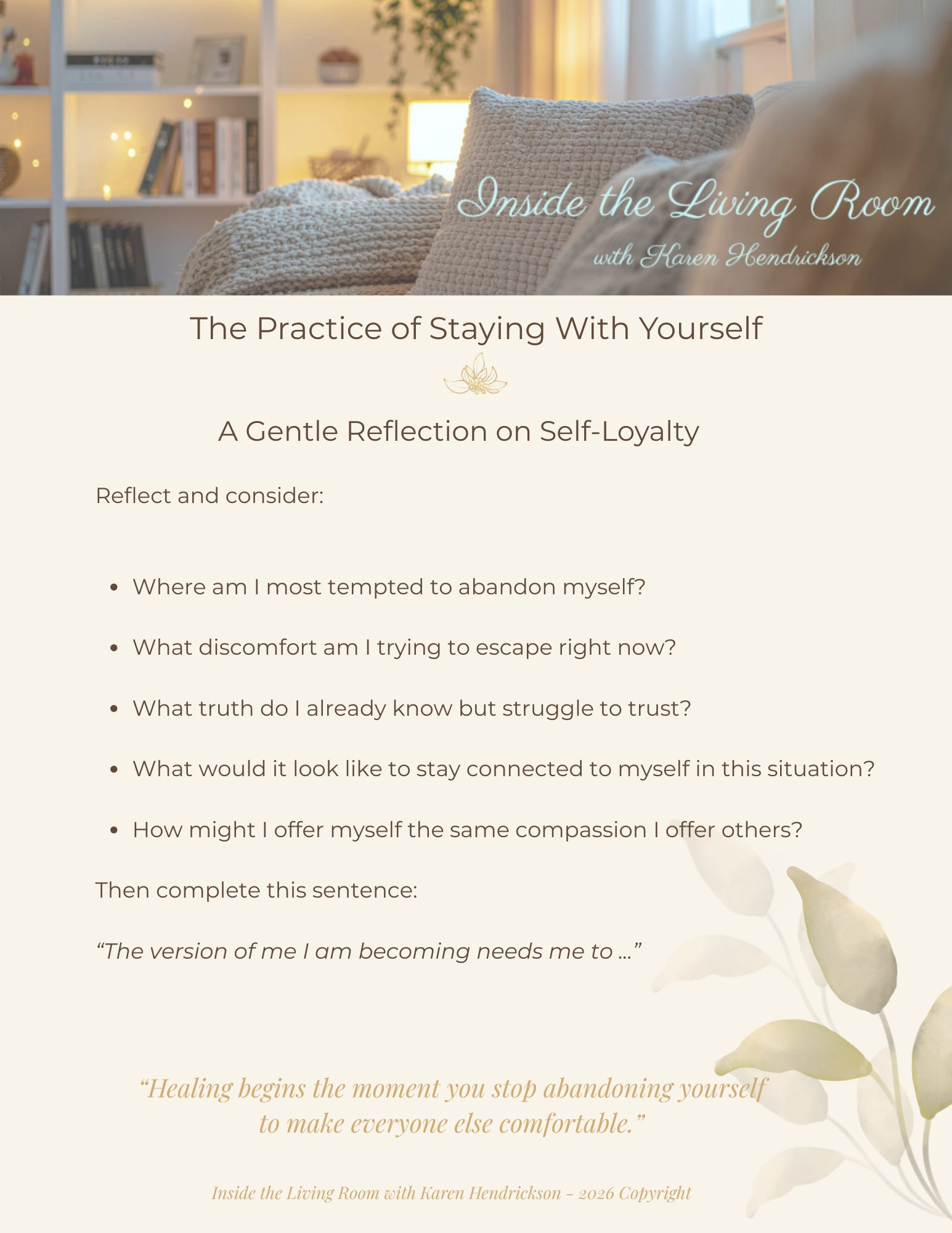
What helps you stay connected to yourself when others don’t understand, agree, or approve? I’d love to hear your comments below. Join the conversation. Let’s chat.
Continuing the Conversation
We’ve spent these past weeks learning to recognize ourselves, speak honestly, carry less, and remain beside ourselves. Next, we’ll begin a different conversation—not about what we’re leaving behind, but about what we’re now ready to create. We’ll begin by honouring the woman who carried us this far before gently asking who we’re becoming next.
Until next time, be gentle with yourself.
You are always welcome to Inside the Living Room.
Go gently,
—Karen
Writer, reflective practitioner, curator, and creator of Inside the Living Room—a space for women navigating emotional exhaustion, caregiving, grief, and the journey of returning to themselves.
_____________
Inside the Living Room is a growing collection of essays, reflection tools, and conversations for women navigating emotional exhaustion, caregiving, grief, over-responsibility, and the journey of reconnecting with themselves.