

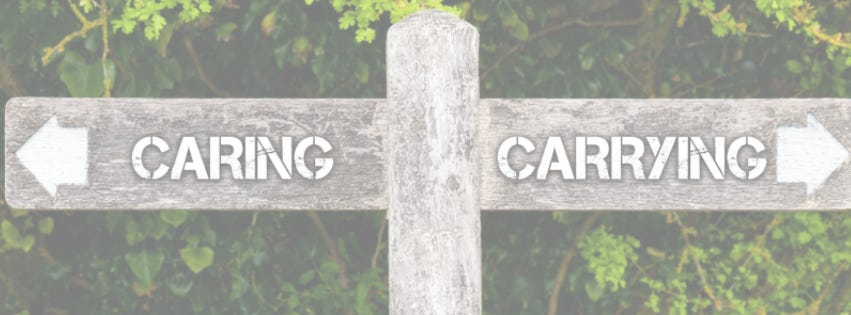
For much of my life, I believed that loving someone meant helping.
Showing up.
Supporting.
Being available.
Doing whatever I could to make life a little easier for the people I cared about.
Those things still matter to me.
I still believe love is often expressed through presence, generosity, and care.
But what I have come to understand is that somewhere along the way, many of us learn something else.
We learn to carry.
Not simply care.
Carry.
And there is a difference.
For years, I did not recognize that difference in my own life.
When someone I loved was struggling, I struggled too.
When they were afraid, I felt responsible for helping them feel safe.
When they were overwhelmed, I stepped in.
When they were hurting, I tried to make it better.
At first, this felt like love.
And perhaps some of it was.
But over time, I began carrying responsibilities that were never fully mine.
Not because anyone asked me to.
Because I believed that was what caring people did.
I see this often in women.
Especially women who have spent years caregiving, parenting, supporting partners, helping family members, or holding communities together.
We become so accustomed to anticipating needs that we stop noticing how much emotional weight we have taken on.
We monitor moods.
We manage tension.
We smooth conflict.
We absorb worry.
We carry concerns that belong to other people.
And eventually, we become exhausted.
The difficult thing is that carrying often looks admirable from the outside.
People describe us as:
selfless,
dependable,
generous,
strong,
caring.
What they rarely see is the cost.
Because carrying someone emotionally is very different than caring for them.
Caring says:
I love you.
I support you.
I am here with you.
Carrying says:
Your pain is my responsibility.
Your happiness is my responsibility.
Your choices are my responsibility.
Your healing is my responsibility.
And that is a burden no one can sustain for long.
I remember periods during caregiving when I became responsible not only for tasks, appointments, medications, and logistics, but also for emotions.
I wanted the people I loved to feel comforted.
Safe.
Reassured.
Less afraid.
Less alone.
Those desires came from love.
But over time, I began trying to carry things I could never truly control.
I wanted to protect people from pain that was not mine to remove.
I wanted to solve struggles that were not mine to solve.
And when I couldn’t, I often felt as though I had failed.
That is one of the dangers of carrying.
It quietly convinces us that we are responsible for outcomes that were never ours to own.
Eventually, I began asking myself a different question.
What if supporting someone does not require carrying them?
What if love can exist without self-abandonment?
What if compassion can exist alongside boundaries?
Those questions changed something for me.
They helped me understand that healthy care is not measured by how much of yourself you sacrifice.
It is measured by your ability to remain connected to both yourself and the other person.
To support without rescuing.
To love without controlling.
To be present without becoming responsible for everything.
This is still a practice for me.
There are days when I slip back into old habits.
Days when I want to fix, manage, protect, or carry.
Days when someone else’s struggle feels heavier than my own wellbeing.
But I am learning.
Learning that people can experience discomfort without me rushing to remove it.
Learning that other adults are allowed to carry their own emotions.
Learning that saying no does not mean I care less.
Learning that boundaries are not barriers to love.
Sometimes they are what allow love to remain healthy.
Most importantly, I am learning that I can care deeply without disappearing in the process.
And perhaps that is the invitation for all of us.
Not to become less caring.
But to become more aware.
More honest.
More discerning about what belongs to us and what does not.
Because loving people well should never require abandoning yourself.
And caring should never cost you your own life.
“You can love people deeply without carrying their entire emotional world on your shoulders.”
Weekly Living Room Reflection
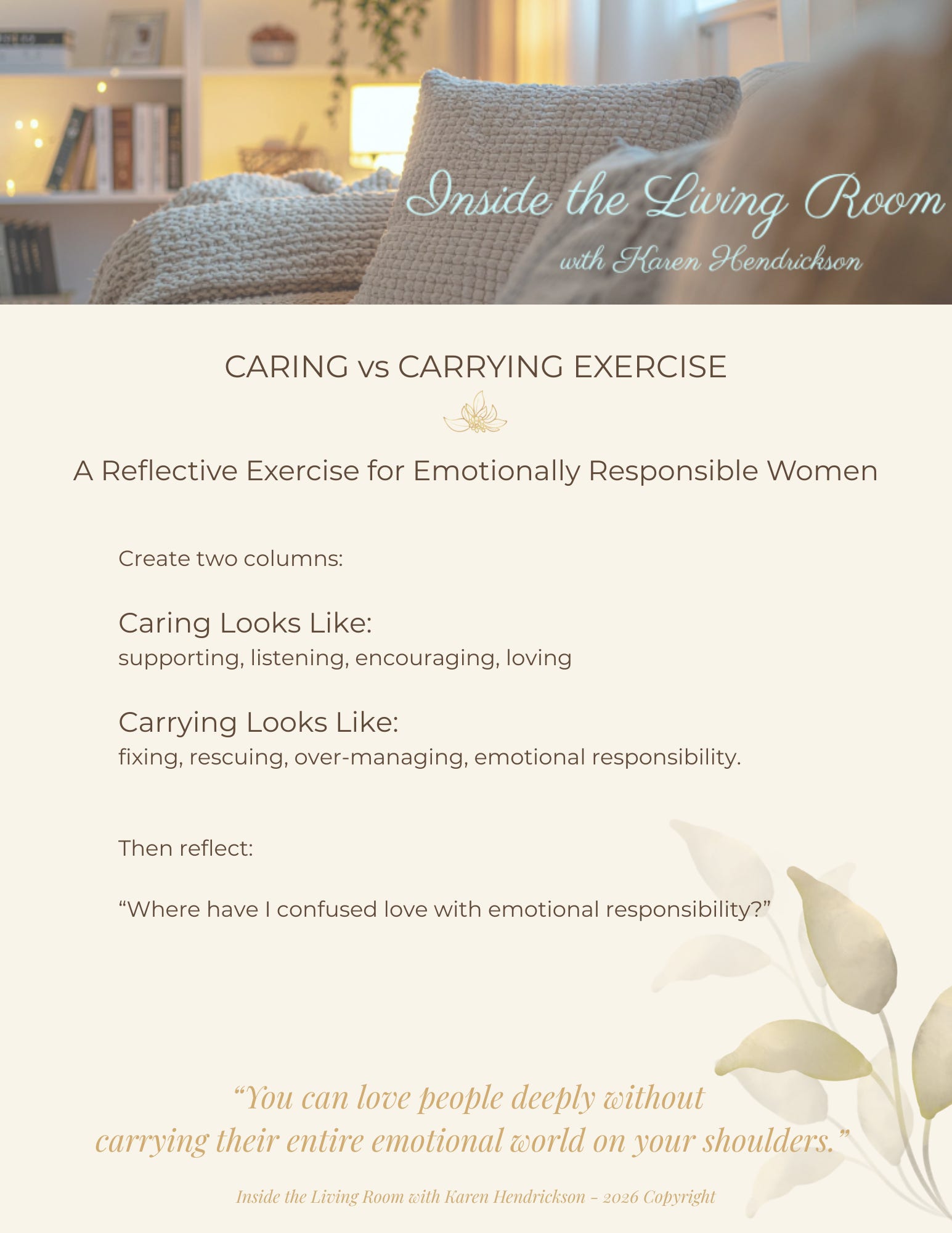
Reflection often begins with awareness, but awareness alone rarely creates change. This week’s reflection is designed to help you gently explore the ideas we’ve been talking about together. There are no right or wrong answers - only an invitation to notice what has been quietly shaping your experience.
Many women confuse love with responsibility. This reflection helps separate what is yours to hold from what belongs to someone else, allowing you to care deeply without carrying more than you share.
Remember, there are no right or wrong answers - only an invitation to notice what has been quietly shaping your experience.
Take your time. Write honestly. Return to these pages whenever you need to.
You may recognize you are not alone. Share one “ah-ha” you may have discovered with this reflection. Other readers may have discovered the same.
Continuing the Conversation
In the coming weeks, I’ll be sharing additional essays, reflection practices, journaling resources, and conversations exploring emotional exhaustion, caregiving, grief, boundaries, and what it means to return to yourself after carrying too much for too long.
If you found yourself somewhere in this reflection, I invite you to subscribe and continue the conversation.
Until next time, be gentle with yourself.
You are welcome inside the Living Room.
Go gently,
—Karen
Inside the Living Room is a growing collection of essays, reflection tools, and conversations for women navigating emotional exhaustion, caregiving, grief, over-responsibility, and the journey of reconnecting with themselves.