


There is a woman I’d like to introduce you to. You know her well.
She is the woman who survived. She kept going when life asked more of her than she ever imagined possible. She sat beside hospital beds. She held families together. She made difficult decisions. She comforted grieving hearts while quietly carrying her own.
She learned to function on little sleep. She smiled when she was exhausted. She became dependable because someone had to be. She carried responsibilities that no one else even noticed.
And somewhere along the way, she quietly convinced herself that strength meant never letting anyone see how heavy it all felt.
Perhaps you know her, too. Perhaps she has been you.
For many years, I believed that healing meant leaving that woman behind. I wanted to become someone different. Someone lighter. Someone who was less tired. Someone who no longer carried so much.
But the more I reflected, the more I realized something that surprised me. That woman isn’t my enemy. She never was. She was doing the very best she could with the life she had. She loved deeply. She protected fiercely. She endured more than most people ever knew. She got me here. How could I resent her for that?
I think many women reach a season where they begin seeing their survival self through critical eyes. We notice the ways we overfunctioned. The times we stayed silent. The boundaries we never set. The dreams we postponed. The ways we disappeared. And sometimes we judge ourselves for it.
But I wonder if there’s another way. What if, instead of criticizing her...
We thanked her?
What if we acknowledged that the woman who survived wasn’t weak? She was resourceful. She was resilient. She was loving. She simply lived in a season that asked extraordinary things of her.
The truth is, survival asks different things of us than flourishing does. Survival asks us to endure. To protect. To keep moving. To get through today.
Flourishing asks something entirely different. It asks us to soften. To receive. To trust. To rest. To imagine. To dream again.
Those are not betrayals of the woman who survived. They are gifts we offer because of her.
Maybe that’s why I think of this season less as leaving someone behind and more as gently laying down a role that is no longer needed.
The woman who carried you through your hardest years deserves your gratitude. She deserves your compassion. She deserves to hear you say,
“Thank you.”
“You did enough.”
“You can rest now.”
Because the next chapter of your life doesn’t require you to forget her. It simply invites you to let someone else begin leading.
The woman who is learning to laugh again. The woman who is discovering what peace feels like. The woman who no longer measures her worth by how much she carries. The woman who is remembering that she deserves a place in her own life.
As I think about my own journey, I don’t believe I’ve become a completely different person. I think I’ve become a gentler version of the woman who was always there. And maybe that’s how I’ve been slowly healing all along. Maybe that’s what healing looks like. Maybe.
Not becoming someone new. But thanking the woman who got us here...
And lovingly taking her hand as we walk into whatever comes next.
“Healing doesn’t ask us to reject the woman we once were. It invites us to thank her, honour her, and gently let her rest.”
Weekly Living Room Reflection
There is wisdom in looking back with compassion before we look ahead with hope.
Today’s reflection isn’t about fixing the past or wishing you had done things differently. It’s about acknowledging the woman who did the best she could with what she knew. She deserves your kindness. Perhaps for the first time.
Before you begin, find a few quiet moments. Take a slow breath, and imagine.
Imagine yourself ten years ago. Or twenty. Picture the woman who was carrying so much. Look at her with gentle eyes. Notice her strength. Notice her weariness. Notice her courage.
Simply sit with her for a moment.
As you begin to write, do so without editing. Show this woman the love and compassion she deserves. Go slowly. Be gentle.
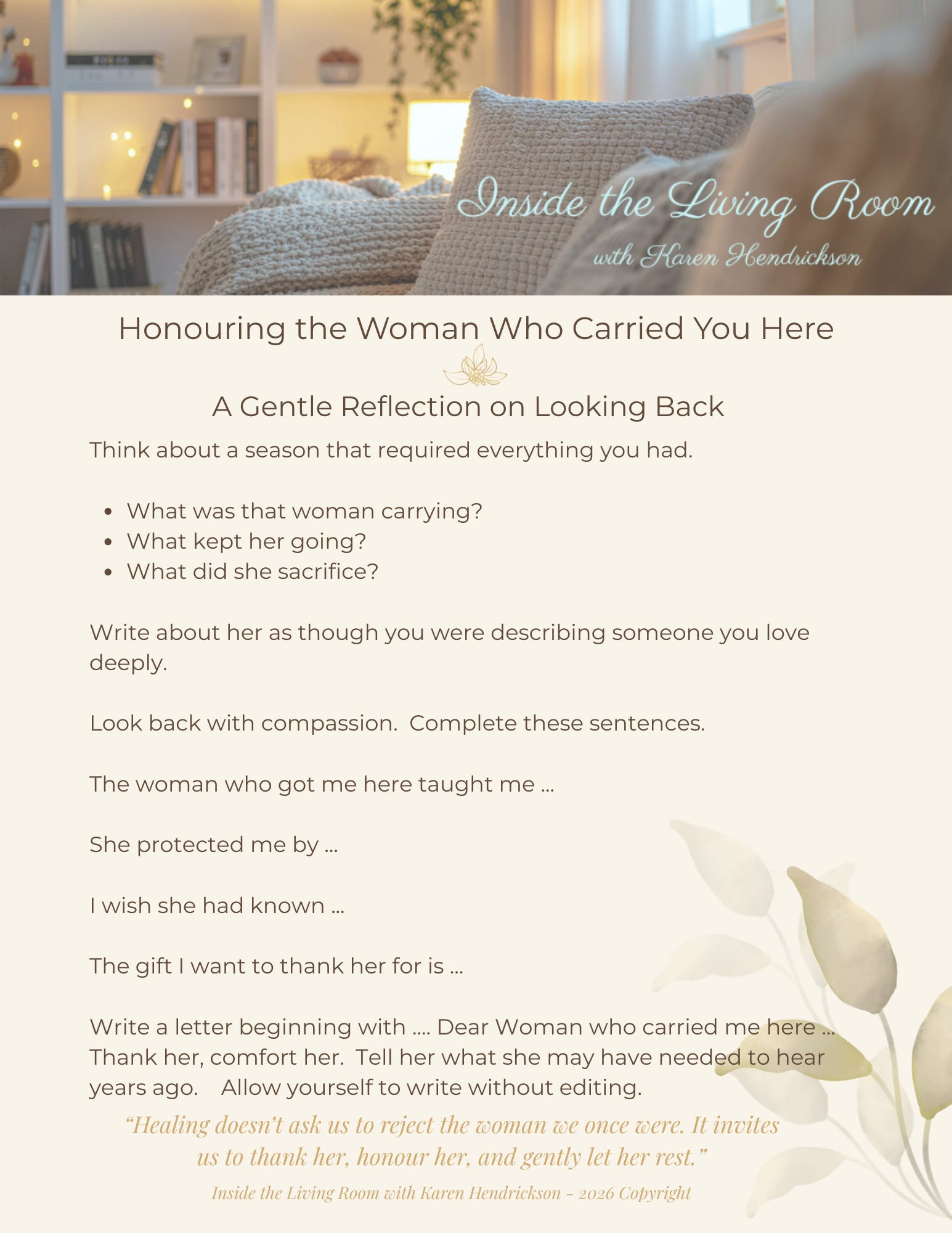
I think it’s easy for us to look back at the woman we once were and judge or criticize. It can often seem harder to look back with compassion and gratitude for getting you where you are today. I’d love to hear about one gift the woman who carried you here has given you. Please share!
Continuing the Conversation
When we’ve spent years believing we must be the strong one, accepting help can feel surprisingly uncomfortable. Next week we’ll explore why receiving can feel so difficult—and why learning to receive may be one of the most courageous acts of healing.
Thank you for spending this time with me.
May you remember that every version of you has been trying, in her own way, to lead you toward this moment.
Today, we simply pause to say thank you.
Until next time, be gentle with yourself. You are always welcome inside the Living Room.
Go gently,
— Karen
Inside the Living Room is a growing collection of essays, reflection tools, and conversations for women navigating emotional exhaustion, caregiving, grief, over-responsibility, and the journey of reconnecting with themselves after carrying too much for too long.