


For much of my life, I measured well being by my ability to function.
Could I manage what needed to be managed? Could I show up? Could I keep moving forward? Could I continue to achieve success? Could I handle what life placed in front of me?
If the answer was yes, I assumed I was doing well. And to be fair, functioning matters. There are seasons when functioning is an incredible accomplishment.
Seasons of caregiving. Grief. Illness. Loss. Transition. Survival.
During those times, simply getting through the day can require tremendous strength. I know that firsthand. There were years when my focus became very small. Not because I lacked dreams or curiosity. Because life required my attention elsewhere.
There were people I loved who needed care. Responsibilities that could not be postponed. Realities that demanded presence. And so I did what many women do.
I focused on what was in front of me.
The next appointment. The next decision. The next task. The next crisis. The next thing that needed my attention.
For a long time, that focus served me. But eventually I began noticing something. I was functioning. Yet I wasn’t entirely sure I was living.
That realization did not arrive dramatically. It arrived quietly. In small moments. Moments when life became a little less demanding, and I realized I no longer knew what I wanted.
Moments when I had time available but little connection to how I wanted to spend it. Moments when I recognized that so much of my energy had been directed toward surviving that I had forgotten to ask what might help me feel fully alive.
I think many women reach this place eventually. Especially women who have spent years caring for others.
We become highly skilled at managing life. But managing life and inhabiting life are not the same thing.
Functioning asks: “What needs to happen?”
Living asks: “What matters?”
Functioning asks: “What is required?”
Living asks: “What feels meaningful?”
Functioning asks: “How do I get through this?”
Living asks: “How do I want to experience my life?”
Neither question is wrong.
But if we spend too many years focused exclusively on survival, we can lose touch with the second set of questions entirely. And that loss can be difficult to recognize.
Because from the outside, everything may appear fine. The responsibilities are being managed. The work is getting done. The family is cared for. The commitments are being met.
Yet internally, something feels absent. Not because life is bad. Because life has become almost entirely about obligation.
I have come to believe that many women are not longing for a different life as much as they are longing for a deeper relationship with the life they already have.
More presence. More honesty. More connection. More meaning. More room for themselves within the lives they have spent years building.
For me, that realization has not led to dramatic changes. It has led to quieter ones. Paying attention to what brings peace. Making room for meaningful conversations. Spending time in places that help me exhale.
Writing. Reflecting. Allowing myself to become curious again. Giving myself permission to ask what I need.
None of these things seem extraordinary. Yet together they have changed the way I experience my life. Because living fully is not necessarily about doing more.
Sometimes it is about becoming more present to what already exists. Sometimes it is about telling the truth. Sometimes it is about setting down responsibilities that no longer belong to us. Sometimes it is about reconnecting with parts of ourselves we thought were gone. And sometimes it is simply about believing that our own wellbeing deserves a place alongside everyone else’s.
The women I know are remarkably capable. They have survived difficult things. Carried heavy things. Loved deeply. Given generously. But survival was never meant to become a permanent destination.
Eventually, there comes a moment when we are invited to ask a different question.
Not: “How much more can I carry?”
But: “What would help me feel more alive?”
That question has no universal answer. Each of us must discover it for ourselves. But perhaps that is the point.
After years of living according to what everyone else needed, perhaps part of healing is remembering that our own lives belong to us, too.
Not only our responsibilities. Not only our roles. Not only our obligations. Our lives.
And perhaps living fully begins the moment we decide to return to them.
“Possibility often returns quietly - long before we fully trust it is there.”
Weekly Living Room Reflection
Reflection often begins with awareness, but awareness alone rarely creates change. This week’s reflection is designed to help you gently explore the ideas we’ve been talking about together. There are no right or wrong answers - only an invitation to notice what has been quietly shaping your experience.
Returning to yourself isn’t only about understanding what you’ve been carrying. It’s also about remembering what still brings you hope, curiosity, and joy. This reflection invites you to gently imagine what becomes possible as you begin making room for yourself again.
Visit this reflection more than once. Let it help you rediscover what living fully means to you. Where can you ignite both joy and possibility as you take small steps toward returning to yourself?
Take your time. Write honestly. Return to these pages whenever you need to.
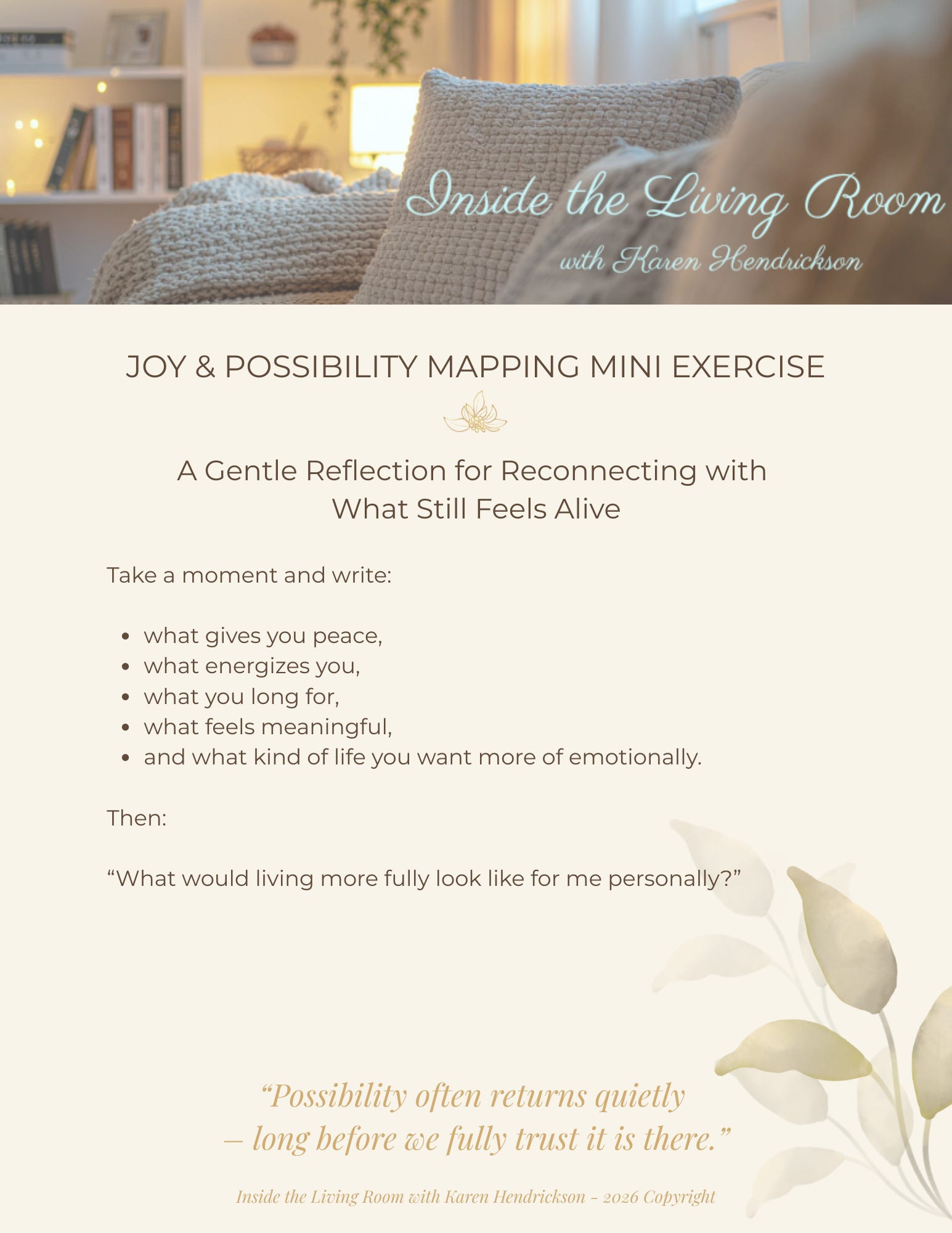
We can all be reminded of what brings us joy. Where we can find hope in possibility again. Share with us how these reflections and exercises may have shifted something within you. Join the conversation. None of us are alone.
Continuing the Conversation
If you’ve been following these reflections, you may have noticed a common thread.
Beneath the exhaustion, grief, responsibility, caregiving, and survival is a deeper invitation:
To return to yourself.
In the coming weeks, I’ll be sharing more about this new space called Inside the Living Room — a place for honest conversations, reflection, and reconnecting with ourselves after years of carrying too much for too long.
I hope you’ll join me.
If you found yourself within the words I’ve shared over these past weeks, I invite you to continue the conversation and pull up a chair. We always have room for one more, Inside the Living Room.
Until next time, be gentle with yourself.
You are welcome inside the Living Room.
Go gently,
—Karen
Writer, reflective practitioner, and creator of Inside the Living Room—a space for women navigating emotional exhaustion, caregiving, grief, and the journey of returning to themselves.
_____________
Inside the Living Room is a growing collection of essays, reflection tools, and conversations for women navigating emotional exhaustion, caregiving, grief, over-responsibility, and the journey of reconnecting with themselves.