


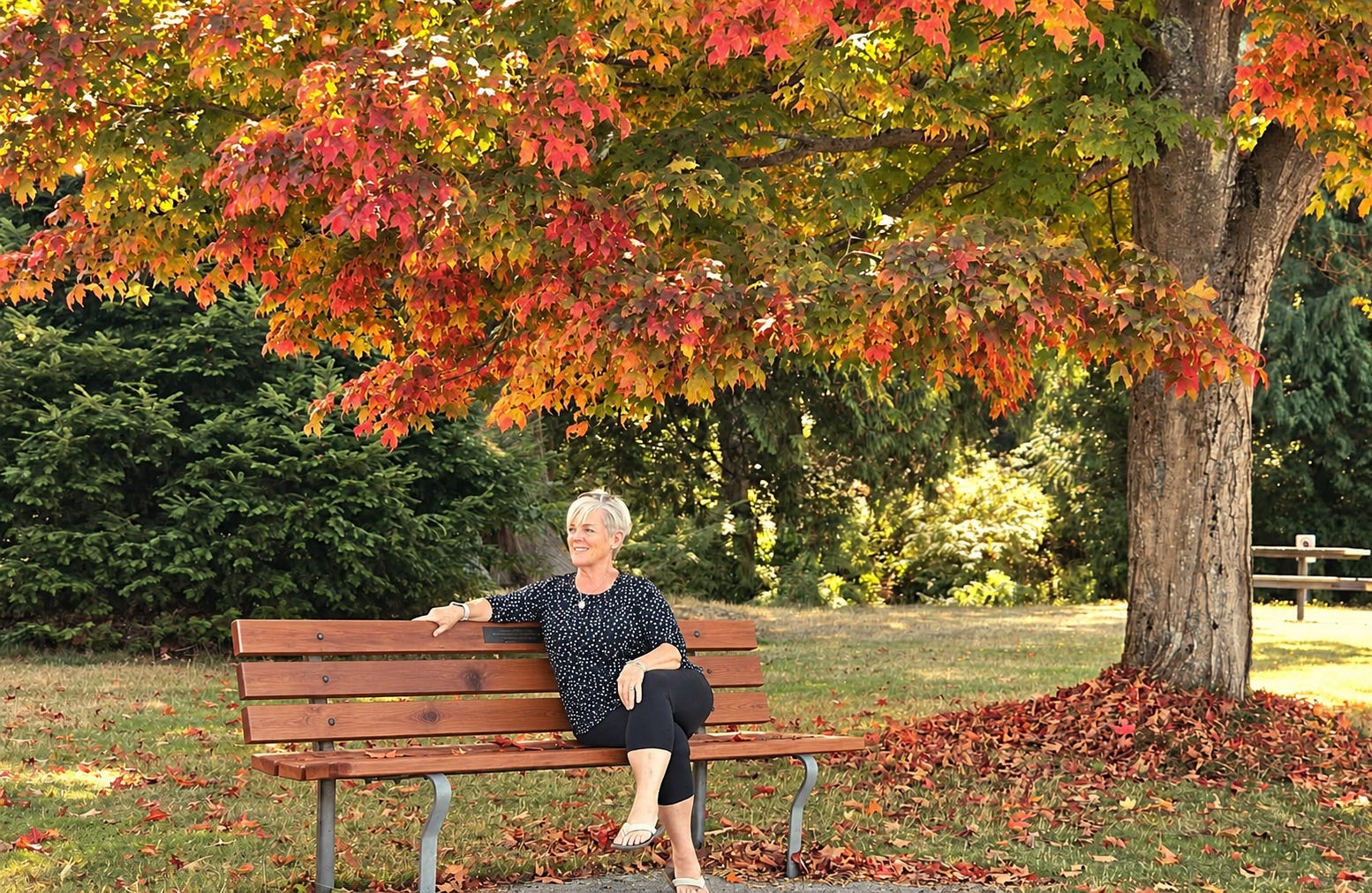
I am turning 64 today.
This birthday has me looking backward as much as forward. Not nostalgically, exactly, but more honestly.
I have been thinking about the stories we tell about our lives. The versions we construct to explain who we are and how we got here.
I was successful. I struggled. I was fortunate. I worked hard. I was strong. I lost myself. I had advantages. I was discriminated against.
At 64, I think I understand something I didn’t understand when I was younger.
They can all be true.
I’ve come to believe one of the privileges of getting older is finally being able to hold the contradictions of your own life without needing one truth to cancel another.
The Doors That Opened
I am a white woman who has lived a relatively privileged life. I can say that now without either apology or defensiveness.
There were obstacles I didn’t encounter because of the colour of my skin. There were places I could walk into without ever wondering whether my race would determine how I was received. I had opportunities, education, safety, and choices that are not equally distributed in this world. I know this.
And I know now, there was another privilege I didn’t really think of as privilege when I was young. I was blonde and conventionally attractive. In a culture that places enormous value on women’s appearance, particularly when they are young, that mattered.
It probably opened doors. And it certainly got me noticed. Yet 64 years have also taught me that an open door and an equal place at the table are not necessarily the same thing.
Getting Through the Door Was Only the Beginning
I built my professional career in the insurance industry, eventually working as an Executive in Human Resources, and later leading Branch Operations.
Many of the rooms I entered were predominantly male. I worked hard. I learned my profession. I took on responsibility. I became very good at what I did.
And still, some people assumed it was my appearance that got me there.
There is something deeply diminishing about working hard for an accomplishment and then having someone suggest—sometimes subtly and sometimes not—that perhaps you didn’t really earn it.
There were sexual comments. There were insinuations. There were expectations of “favours.” There were times when professional attention carried another expectation underneath it. And there was the exhausting balancing act so many women of my generation learned without anyone ever formally teaching us.
Many women will be familiar with this. Be friendly, but not too friendly. Be confident, but don’t intimidate. Don’t encourage him. Don’t embarrass him either. Don’t overreact. Don’t be difficult.
Smile. And whatever happens, remain professional.
Truthfully, and sadly, I’m not sure much has really changed for younger women today.
Back then we became very good at reading rooms. Sometimes we laughed at things that weren’t funny. Sometimes we ignored things we shouldn’t have had to ignore. Sometimes, we calculated whether speaking up would cost us more professionally than remaining silent.
And because I worked in Human Resources, there is another layer to this story I have to acknowledge. I wasn’t simply a woman navigating the system. I was eventually part of the system.
There were times I challenged it. And there were probably times I accommodated things I would challenge much more readily today. This is uncomfortable for me to admit.
Yet maybe wisdom isn’t proving that we always got it right. Maybe wisdom is being willing to look back and say:
I understand something now that I didn’t understand then.
Privilege and Discrimination Can Occupy the Same Life
For a long time, I think we have talked about privilege and disadvantage as though we must choose between them.
Either you were privileged, or you struggled. Either you benefited from the system, or you were harmed by it. Life has taught me that human experience is considerably more complicated.
Being white gave me advantages. Being attractive gave me advantages. Being a woman sometimes put me at a disadvantage. Being attractive sometimes became another way my competence was questioned.
The very thing that might have helped open a door could be used to diminish me once I walked through it. None of that means my experience was equivalent to that of women who faced barriers I never had to face. It simply means two things can be true.
I can recognize the advantages I was given without pretending I never experienced discrimination. And I can talk about discrimination without using it to erase my privilege.
At 64, I don’t need either story to win. I just want to tell the truth.
The Things We Inherited
The workplace wasn’t the only place where I learned what was expected of women. Women of my generation inherited a great many messages about what made a good woman.
Be helpful. Be attractive. Be accommodating. Take care of people. Keep the peace. Don’t be selfish. Don’t complain too much. Make things nice. Remember the birthdays. Hold the family together. And when things get difficult, carry on.
For years, I thought being strong meant being able to carry more. I know much differently now. Sometimes, strength is recognizing what was never yours to carry in the first place.
I spent years caring for people I loved. There were seasons of illness, caregiving, grief, and responsibility when my own needs became increasingly difficult to locate. I didn’t wake up one morning and decide to lose myself. It just happened quietly, like it often does.
One responsibility at a time. One I’ll take care of it at a time. One I’m fine at a time.
And I’m quite sure now, that because being capable had served me so well professionally, I didn’t immediately recognize when capability became overfunctioning in the rest of my life.
That is another contradiction I understand differently now. The qualities that help us succeed in one season can become the very qualities we eventually need to question.
Judgment Looks Different From Here
There is another thing 64 years have changed in me. I am much less interested in judging people. I have lived long enough now to understand how little of another person’s story we can ever see.
The woman who gained 50 pounds. The marriage that ended. The person who drinks too much. The mother who seems overwhelmed. The friend who disappears. The woman who stays. The woman who leaves. The person who looks successful from the outside and goes home exhausted every night.
We only see the outcome. We rarely know the road that led there. I wish I had understood that earlier.
I have judged people. I have made assumptions. I have believed things because they were commonly believed by the people and culture around me.
About race. About gender. About weight. About marriage. About success. About addiction. About mental health. About what a good mother, wife, employee, or woman should look like.
Many of those beliefs I no longer carry. And I hope there are others I haven’t discovered yet that I will still be willing to examine.
I don’t know that getting older should make us more certain. I’m actually feeling that maybe it should just make us more curious.
Becoming the Elder
This has become particularly real as I watch my grandchildren arrive.
The elders were once my grandparents, and then my parents. And of course, they are all gone now.
My children are adults building lives and families of their own. There are babies again. And almost, without even noticing, I have moved toward the other end of the family photograph.
I am the elder. The matriarch. Each time I write or speak about it, I recognize I am still getting used to those words. Because inside, I don’t feel like someone who has accumulated 64 years of wisdom.
I feel more like someone who has accumulated 64 years of questions. And I am beginning to believe that’s exactly what an elder is supposed to carry.
Not certainty. But perspective.
What Do We Do With What We’ve Been Given?
And I feel this may be the question I find myself returning to most. What do we do with what we’ve been given?
I don’t believe acknowledging privilege requires us to apologize for every good thing that happened in our lives. But I do think awareness asks something of us.
If I have been given a voice, how do I use it? If doors opened for me, can I hold one open for someone else? If I understand now how it feels to have your competence questioned, can I make sure I don’t do that to another woman?
If I have learned how destructive judgment can be, can I become slower to judge? If I have spent years learning about grief, caregiving, boundaries, loss, and returning to yourself, can I use those experiences to make another woman feel less alone?
I am believing privilege becomes most meaningful when it becomes responsibility. Not guilt. Responsibility.
I Don’t Want to Defend the Woman I Was
At 64, I find myself less interested in defending every decision I’ve made. At this stage that’s just way too exhausting to even think about.
I don’t need my younger self to have understood everything. She couldn’t have. She was living inside the culture, expectations, and assumptions of her time. Sometimes she challenged them. Sometimes she benefited from them. Sometimes they hurt her. Sometimes she probably perpetuated them without realizing it.
What I do know for certain is that She loved. She worked. She succeeded. And she failed. She cared for people. She carried too much. She got some things very right. And undoubtedly got others wrong.
I don’t want the next chapter of my life to be spent defending the woman I have been. I want to remain willing to become someone wiser. Softer in some places. Braver in others. Less certain. More compassionate. More willing to listen.
More willing to say I was wrong.
More willing to say I didn’t understand.
More willing to notice who isn’t in the room.
And more willing to use whatever place I have in this world to make a little more room for somebody else.
Maybe This Is What 64 Years Give Us
Sixty-four years haven’t given me all the answers. Thank goodness.
They have taught me that being fortunate doesn’t mean you haven’t suffered. That suffering doesn’t erase privilege. That beauty can open doors and still become a weapon used against you.
That success doesn’t necessarily mean you felt worthy of it. That being needed isn’t the same as being loved. That strength isn’t measured by how much you can carry. That the people we judge usually have stories we cannot see. That some of the things we were taught deserve to end with us.
That changing your mind isn’t weakness. That saying I didn’t know can be the beginning of wisdom rather than an admission of failure.
And that time is far more precious than I understood when I believed there would be always more of it. When I stand here now, in the last quarter of mine.
I don’t know how many years I have left. None of us do. I do know I want to spend mine differently.
Not trying to prove that I was good. Not pretending I was always right. Not denying the advantages I was given. And not diminishing the difficult things I have survived.
Just trying to live with my eyes a little wider open.
To listen better. To judge less. To love well. And to remain teachable.
And to leave something gentler behind for the people who come after me.
Isn’t that one of the greatest gifts of getting older?
We finally realize we don’t have to make our lives look simple in order for them to have been meaningful. We can tell the whole story.
The privilege. The pain. The mistakes. The accomplishments. The losses. The love. The things we carried. The things we finally learned to put down.
All of it.
And then, with whatever time remains, we get to decide what we want to carry forward.
This is the life I have lived.
These are the truths I can hold.
I no longer need one to erase the other.
A Song for This Story: Joni Mitchell - Both Sides Now
Perhaps Joni Mitchell had it right all along. We spend a lifetime looking at life from both sides—and eventually discover that wisdom isn’t choosing which side was true. It’s learning to hold them both.
If this story stirred something in you, perhaps it has reminded you of one of your own.
The moments that shape us are rarely the loud ones. They are often the quiet experiences that continue to echo through generations, inviting us to see our lives with fresh eyes.
Thank you for letting me share this part of mine.
Until next time,
Go gently,
Karen
I’d love to hear one of your stories. If this piece brought a memory to mind, you’re always welcome to share it in the comments. Sometimes, the stories we tell one another become the stories that stay with all of us.
Thanks for reading! This post is public so feel free to share it.
Inside the Living Room is a growing collection of essays, reflection tools, and conversations for women navigating emotional exhaustion, caregiving, grief, over-responsibility, and the journey of reconnecting with themselves.
Oh, I loved reading this Karen! So much that is relatable as I approach 69. May we continue to widen and soften into our elderhoods!